Add to Technorati Favorites
Showing posts with label wikis. Show all posts

Saturday, 9 October 2010

Teaching Tech-Savvy Kids

Image: Book cover: Teaching Tech-Savvy KidsAlthough written primarily for an American readership this book represents a breakthrough in making sense of an often mysterious and arcane world of Web2.0 and Digital Media. It should be compulsory reading for all involved in the education of our children throughout the world. Although, frustratingly, the book does not mention ePortfolios, all of the references to digital media can be seen as tools and artefacts which can be so eloquently presented through the medium of the ePortfolio.

The book is of equal benefit to parents, teachers and educational technologists. It brings into sharp contrast the massive potential that young students have today and the often sad failure of educationists to recognise it.

The two strap-lines, 'Bringing Digital Media Into the Classroom, Grades 5-12' and 'Students are plugged in, powered up, and connected. ARE YOU?' says it all.

Based on well-researched materials Jessica Parker writes with the expertise of a classroom teacher (as she was for many years) combined with that of an assistant university professor (as she is now - BA Media Studies, MA and PhD in Education).

Liberally appended to each chapter are impressive lists of references and helpful resources along with a very useful glossary and a comprehensive index. As one reviewer states:

"Until we understand the powerful learning, collaborating and producing that teenagers do with their cell-phones, MP3 players, laptops and the Internet, we won't understand how we can best utilise those technologies in our classrooms. Whether you're a digital native new to the classroom or a veteran teacher struggling to learn your students' Internet lingo, this book is your guide to 21st-century teenagers, literacy and learning. After 17 years of teaching middle-school English, I know that I can't teach literacy today without this book."

Wednesday, 11 August 2010

ePortfolios in the U.S.: Slowly Catching on

Dreamstime Image: Girl thinking at laptopFor an independent view of the ePortfolio scene I have asked Kate Cunningham (see below) to present her views of ePortfolio progress in the US. This is a frank summation, uncluttered by the wishful thinking of ePortfolio evangelists or student enthusiasts. Read on!

While ePortfolios have gained popularity throughout the globe as the future of learning and presentation, their institutional implementation across the American school system is sadly lacking. In fact, ePortfolios do not have broad base use in higher education, although about 100 institutions represented themselves at a recent global technology conference to talk about ePortfolios.

There are, of course, Virtual Learning Environments in different American Universities. I only recently graduated from an American institution of higher learning, and it was here that the school's specific VLE, powered by the Sakai Project, was used. While the tools provided through this specific VLE were functional enough, I was taken aback by how little it was used.

When I asked friends attending different universities, the extent to which they used a VLE was just as minimal. Of course, the VLE was certainly popularly employed for the dissemination of grades, the uploading of assignments, and the downloading of various course texts. However, for the sake of preserving student work, creating multi-format presentations, or accomplishing anything that would be of a lasting nature, university IT tools were short of the mark.

Wikis are more commonly used within the university structure, although, again they are not implemented on a basis that crosses through courses. In my experience, certain professors asked their students to use Wikis, but most didn't. In one specific course that stands out in my mind, we used a Wiki not just as a place to post assignments but also as a presentational platform to show our work to everyone in the class, as well as to work together on group projects by editing pages together.

While the ePortfolio idea has not yet taken off in the United States, Campus Technology, an American monthly dedicated solely to the use of technology in institutions of higher education, reported in July on the AAEEBL's first world conference set in Boston. The AAEEBL, which stands for The Association for Authentic, Experiential, and Evidence-Based Learning, convened to discuss the nature of "a profoundly disruptive technology"--ePortfolios.

The article noted:

“With the advent of AAEEBL, a global collaborative, the portfolio conversation has quickened, deepened, and broadened. Now, well past the trough of disappointment portfolio has a global association affiliated with all existing portfolio initiatives and organizations. The work is just beginning.”

Indeed, the work is just beginning, but now that more and more are talking about ePortfolios and their powerful learning tools, comprehensive implementation will be the next step. It will certainly take some time.

By-line:
This guest post is contributed by Kate Cunningham, who writes on the topics of online university rankings. She welcomes your questions and comments at her email Id: cn.kate1@gmail.com .

Wednesday, 16 June 2010

Blogs as Web-Based Portfolios

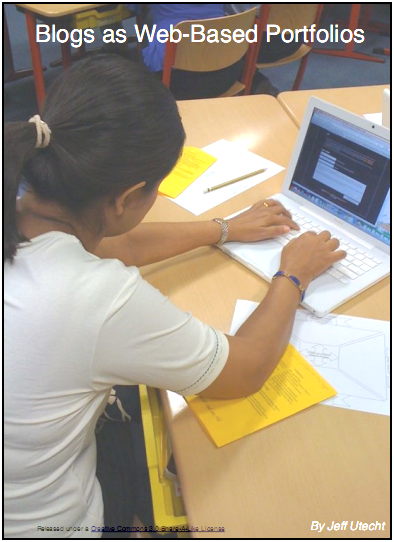
Photo: child blogging on a laptopI pounced upon this free book (13 pages) by Jeff Utecht as soon as I saw the title, 'Blogs as Web-Based Portfolios' for two reasons. Firstly, because I found Jeff's easy to read style to be quite fascinating (I have referred to this in my previous post) . However, unfortunately, my second reason for it grabbing my attention was that the title was like a red rag to a bull - and thus for this post!

For several years now, and almost every day, I have been reading the various blogs, wikis and e-Portfolios of undergraduates, trainee teachers and students. Repeatedly I have found myself asking questions about how much guidance the students have had relating to e-Portfolios and what sort of challenges teachers or lecturers have been presenting to their students. Even the most articulate of students I find referring to a blog as their e-Portfolio.

Despite my interest in 'all things technical' I still think as a teacher and a leader of staff. To this end I would argue against the many who think that a blog or a wiki is a suitable tool for presenting an e-Portfolio. Quite simply, a good e-Portfolio is so much more. Yes, it can include blogging tools or wikis, it can include links to a whole range of Web2.0 tools, but, as Nick Rate points out (slide 15), these are all contained within the e-Portfolio. I just do not see a tool like Wordpress meeting the vast range of pedagogical activities one would expect within an e-Portfolio.

As I have repeatedly said, if the e-Portfolio is to be fully portable, learner owned and lifelong it must be hosted externally to any institution and yet, at the same time afford the security and reliability that schools require and without adding an additional workload for staff.