Add to Technorati Favorites
Showing posts with label home access. Show all posts

Friday, 5 November 2010

Escaping the Stone Age - II

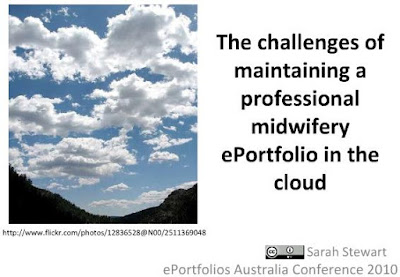
Screenshot of Sarah Stewart's SlideShareClick above to see the SlideShare


I have been following the progress of Sarah Stewart's work, exploring how the ePortfolio can serve the midwifery service in Australia. Her presentation, as indicated above, is a valuable consideration of the problems involved in introducing ePortfolio thinking into any community.

However, many of her 'frustrations' follow on from my previous post, that of overcoming 'Stone Age thinking'.

Perhaps one of the first issues to overcome is that of the technology. If it looks complicated then it IS complicated. For adults who are not as IT savvy as they could be, and have plenty of other things on their minds, it is essential that whatever ePortfolio system they choose, it should be 'childsplay'. It should be easy to use and immediately attractive.

Secondly, Sarah's presentation illustrates the generation gap in ePortfolio thinking. It was not only the midwives who found difficulty in adopting ePortfolios, it was the assessors and administrators who were at least reticent if not downright reluctant. It is time that governments recognised this situation and sponsored urgent adult training in ICT for all generations - and particularly for services, such as midwifery, that require portfolios.

Yes, the lack of equipment, of resources and of broadband availability needs to be recognised - and it may be some time before much of Australia gets the service it deserves!

However, speaking as an experienced teacher, it would appear that Education Authorities must reflect upon their own consciences and ensure that the upcoming generation is properly and speedily trained as the 'net generation. One thing that we have learnt here in the UK is that by ensuring that our children have good 'Home Access' that their parents, carers and even grandparents are having to learn ePortfolio thinking.

Thursday, 4 November 2010

Escaping the Stone Age

I was recently in conversation with a respected colleague, and we were bewailing the 'Stone Age' mentality of some of our teachers and how they were holding back our children's learning. Inevitably, I wanted to shout out that the ePortfolio, and eFolio in particular, was the answer to the whole problem. However, in a more reflective moment I came up with four suggestions:

1. The ePortfolio can act as an information service found by all permitted parents/ carers/ mentors/ grandparents etc. This facility should act as a structured information service, an educational 'agony aunt' and also a confidential hot-line where questions about educational practice can be properly and securely discussed.

2. It is essential therefore that schools start understanding that Personal Learning Environments are the way forward and that tools are urgently required that can enable students to move forward at their own speeds and enable the following of their interests. Eventually, I suspect, this will be a Web3.0 environment but certainly an ePortfolio will be involved.

3. I do hope that when schools do manage to catch up with the technology, teachers will be able to check HWKs (and for that matter classworks) on-line, provide feedback to the kids, and modify their lesson plans if necessary, BEFORE the next lesson.

4. It is an absolute MUST that schools should publish their schemes of work in Easy English over their VLEs but preferably within the ePortfolio scaffolding, so that any parent, carer or mentor can help the child to understand 'where they are, where they want to go to and by what processes they will get there'. These should be specifically and constructively written for every subject area. Schools must recognise the benefits of 'the Home-School Nexus'.

However, rather than just describing the ePortfolio as a tool to support 'good practice', another approach would be to try and identify the prefered educational outcomes - and then decide what tools could best achieve the required results. Below are two fundamental questions and my suggested responses:

Q) What do parents, governors and politicians think ought to happen more or better to create better learning?

A: Pupils should be more engaged with their learning and as a consequence would be more productive and would be more proud of the ownership of their learning. They should have access to their work 24/7 so that they can work as and when suits them.

Q) Imagine yourself saying "The use of ICT has got the pupils ?????????.......... so much more/so much better". What, as a teacher would you hope to see?

A: Children are now more able to explore safely for themselves. They know how to phrase the right questions when searching for information. They can learn things not immediately obvious from the school curriculum or exam syllabii. They communicate better with both their peers and teachers. They are more able to learn from and to provide feedback. They will not take one person's opinion as 'gospel' but will clarify/verify what they have been told. They are more aware of things happening around the world. They understand more about different cultures or mindsets. They understand that learning is not a 9-4 occupation but that learning happens all the time. They are more questioning - they will not take 'impossible' as an answer but will explore alternative solutions.

I can visualise so many scenarios where the use of a collaborative ePortfolio is the right place for all of these learning experiences - and possibly with no teacher in sight! And not only 'learning' but also reflection, internal adoption and, inevitably the pride of ownership of ones learning as seen through the showcasing of appropriate artefacts and reflections.

Wednesday, 4 August 2010

Multimedia and ePortfolios

Photo: A group of children around a laptop in their classroom.I have just read an excellent article by Barbara Schroeder extolling the virtues of using multimedia in the classroom. But why the empasis on the 'Classroom'? Why not everywhere? Why not at home? Why not on a long car journey or on the bus to school? And certainly why not in their ePortfolios?

Many of the features of Multiple Intelligences, motivation, collaboration and peer-review etc hinted at in her post I have previously attempted to address in this blog. As I have said elsewhere, "If a picture is worth a thousand words, what value can we put on a video!" - Or for that matter any other graphical or aural media?

Thank you, Barbara, and GGfL for an excellent promotion of all that is so educationally apposite about using multimedia in ePortfolios as well as the classroom.

Monday, 21 June 2010

3-Way Interviews

Graphic: From Jamin Lietze's postMy friend Jamin Lietze wrote a very interesting post back in May. I have a very high regard for the work that he has put into developing e-Portfolio understanding for Primary schools in NewZealand. However, he raised an issue that I first came across in the work of John Pallister (some 4 years ago) in the UK and his work for MOSEP.

At that time John Pallister was running his 'eME' portfolio system 'in house' and, just like Jamin, used the student's e-Portfolio as the medium for discussion at short school-based 'Parent-Teacher Interviews'. The children would show their parents examples of work showcased from their VLE-based 'eME' system, parents would "Ooo!" and "Ahh!" at the right places and generally would see work that they had not seen before or did not even know about.

Obviously, as long as the majority of parents do not have on-line access to their child's VLE this 'shock-of-the-unknown' will continue in the same way as parent-teacher meetings did long before computers arrived in schools. But this brings out a valuable point. As more and more schools are opening up their VLEs for home access so the shock of the unknown or misunderstood should soon disappear. The regular sharing of learning experiences by children with their parents, mentors and peers will encourage both face-to-face and on-line feedback which will make the traditional parent-teacher meeting obsolete. Instead, one would hope that the 3-Way meeting will become a time of social pleasantries, celebration and constructive discussions where all are better informed. - Even cups of tea and cucumber sandwiches to talk over! (Never like that in my day!)

Perhaps the traditional 'Parents Evening' might even become a thing of the past?

Wednesday, 14 April 2010

Developing a Networked School Community

Graphic: Front cover of the bookA guide to realising the vision – edited by Mal Lee and Glen Finger.

This book is a first in its class and should be found on the headteacher’s desk of every school. Its well-paced and easy read style presents a profound array of research in its twenty chapters from around the world. The authors argue for the application of ‘flat world’ thinking to all areas of teaching and learning. The extensive bibliography substantiates the combined wisdom and experience of a host of authors.

At 355 pages the book demands serious responses from its readers. Schools will never be the same again. Pedagogies must change, infrastructures and digital tools will inevitably change. Communities will emerge or be strengthened in ways never previously imagined.

Although digital technologies in industry, commerce and the home have become increasingly outward looking it is generally the case that where schools have become increasingly digital they are still slow to engage with the wider world. One quotation from the book must suffice:

“Notwithstanding, across the developed world education authorities, schools, and indeed national governments that have moved to a quite different digital operational mode, have begun to remove the traditional school walls and disturb the traditional conception of timetabled formal lessons, and use the opportunities provided by the networked technology to move into a third distinct phase of schooling, which is strongly networked and collaborative in nature and is starting to involve the students’ homes more fully in teaching and learning.”

Here, yet again, is a perfect example of where eFolio can provide that safe interface between the world, the school and the home. Anyone reading 'Developing a Networked School Community' must see the value of the e-Portfolio as the perfect Lifelong and Lifewide solution.

Contacts:
Australian Council for Educational Research
19 Prospect Hill Rd, Camberwell VIC 3124
t: 03 9277 5447
f: 03 9277 5499
e: sales@acer.edu.au
UK & Europe:
The Eurospan Group
3 Henrietta Street
Covent Garden
London WC2E 8LU
T: 020 7240 0856
F: 020 7379 0609

Sunday, 11 April 2010

home-school relationships - 1

The FuturLab report, 'Developing the home-school relationship using digital technologies', published a few weeks ago, is a useful statement of the present situation, warts 'n all. Illustrated profusely throughout its 68 .pdf pages and well documented, I wonder just how brief FutureLab's message really is.

For me, I get a similar sense when reading the document as when I see other publications by Becta on Parental Engagement - 'It all seems a bit one-sided'. It all seems to be about telling parents what the school does and what the parents should be doing. Yes, there are occasional statements about listening to 'pupil voice' but generally the data-flow all seems a bit one-sided. Again, although I believe in on-line reporting in its full and wholesome potential, many fear that the term relates only to the dreaded 'REPORT' mentality which usually tends to highlight a pupil's failings (eg times late, detentions etc) rather than their merits.

Obviously, I tend to look at any report in terms of its references to e-Portfolios, again, only one brief reference in passing to something that might be implemented in the future. As regular readers will recognise, I see the e-Portfolio as being the tool par excellence for communicating to parents both the progress of their child(ren) in real time and the apposite place for formative feedback.

Photo: Grandmother and pre-school child with a workbookWhat I do not see in this report, as with other Becta publications, is any mention of the facility for TEACHERS to take notice of what learning takes place outside of school which is NOT school directed. The e-Portfolio is very much a two-way process as opposed to Becta's uni-directional approach of TELLING the parents. The e-Portfolio can resolve a very real dilema - that of parents not knowing how children are taught, but also that schools should be aware of what happens in the home, in the ballet class, the Saturday morning football fixture or the additional private tuition.

Thursday, 10 December 2009

Schools and Parents: a New Partnership?

Graphic: page of the document showing a teacher and children.Niel McLean, Executive Director, Becta, the government agency for technology in education discusses (November 2009) how technology supports a new relationship with schools. In his introduction he writes:

"Good parental engagement is fundamental to children’s learning and closely linked to increased attainment. One of the more effective ways for parents to engage in their child’s learning is to maintain good communication with a school, learning more about their child’s progress whilst also helping to identify any development or performance issues early on."

The website is very attractive and, for those who can find it, provides a lot of thoughtful material, including the 16-page .pdf document.

Yes, school VLEs or MLEs are as essential as the Home Access Programme. However, yet again, the mention of e-Portfolios is significant by its absence. School may be one part of e-Learning and before long it is hoped that teachers will begin to realise that remote on-line access will change the ways teaching & learning is enabled.

But, as I have repeatedly said, the major part of a child's learning takes place outside of the four walls of the classroom. It is the e-Portfolio that can document all the other forms of informal, casual or experiential learning that enables teachers, parents, new school or colleges as well as employers to see the 'whole person'.

Saturday, 14 November 2009

Where does Learning take place?

Graphic: Venn diagram of the connections of a 'networked school'.Adults, or certainly those in Higher Education, may be free to do their learning when and where and from whom they like. However, the same is not equally true for those younger students or even adults who need some guidance.

Bob Harrison recently quoted on a NAACE forum the following from 'The Impact of ICT in schools-a landscape review-Becta 2007' :

'While this study has looked closely at the impact of ICT on how pupils learn and how this might be enhanced....it has not addressed the impact of what they learn or where learning takes place and whether the schools of the future will be the physical entities we have today.'


Some two years later we still do not have clear answers and probably there will not ever be one set of answers which will suit everyone. However, building upon Mal Lee's graphic of the 'Home-School Nexus' (highlighted in the above diagram in blue) and looking further to Networked School Communities, I have tried to identify most of the major influences affecting any young learner. The nature of 'Virtual Learning' and how this might impact on current school practice and 'physical entities' will be explored more in my next post.


What young people learn has been the centre of discussions and the culture of a digitally aware society has begun to impact on curriculum design in most of our schools. Whether examination boards are ready to develop new ways of assessing learning is another question altogether.


How young people learn in a digital age is still not well-defined. Despite the fact that many schools may have an abundance of digital appliances, schools may still have a large proportion of teachers who believe in the "I teach, you listen" philosophy. The problem with this is that where children attend such a mixed-strategy school, it is doubtful that either system can be successful. And, again, despite a tacit recognition of the theory of Multiple Intelligences, it is often the case that lesson after lesson the children only experience one form of teaching and learning.


When and where young people learn has been the subject of much discussion and in some cases a serious indictment of our academic culture. We tend to expect children to learn only in lesson time and do not appreciate the vast amount of 'out-of-school' time which can be rich with experience and capable of much reflection and collaboration with others outside of the immediate home-school environment. Although the following graphic might raise some questions about the quality of the research relating to students in Holland, again, it raises questions about whether tapping into the power of modern media is recognised by schools as having any real merit.


Graph: Student media use per dayfrom: CISCO Equipping_Every_Learner_for_21st_Century_White_Paper.pdf

The question is, do these figures represent total media usage by students in your country or is Holland different to other countries?

Tuesday, 13 October 2009

E-Portfolios in Rural Communities

Photo from: 'http://www.socwk.utah.edu/'Adrienne Carlson has contributed the item below. Its full title should read, 'How to Raise Awareness of E-Portfolios in Rural Communities'. Of course, we have the Home Access Programme in England but that is only the begining. Having the technology is one thing, getting both teachers and learners to use it is another, as Adrienne writes:

There are various reasons teachers use e-portfolios – from enhancing their profiles to developing their knowledge and skills, it helps them improve personally and professionally as members of the pedagogic society. But their counterparts in rural communities are not blessed with the same advantage, because they hardly have access to technology let alone the wherewithal to use it on a regular basis to create, develop and maintain an e-portfolio. If we are to raise awareness of e-portfolios in rural communities, we must:
  • Introduce technology as a regular teaching tool: Since e-portfolios are linked to technology, it follows that technology must be made a teaching tool in rural communities before it can be harnessed for the purpose of e-portfolios. One way to do this is through grants and other forms of funding, but more than that, efforts have to be made to introduce teachers to technology and encourage them to use it without any hesitation. And to do this, we must teach them to use the technology with the right kind of training.

  • Train teachers to use technology: Most teachers (or anyone else for that matter) who don’t have much contact with technology are usually intimated by it. They refuse to even attempt to learn it because they are scared that they will not be successful at it. Any training program should address these issues and manage the apprehensions of teachers before attempting to teach them how to use technology as a teaching aid.

  • Introduce them to e-Portfolios: When teachers realize the value and usefulness of e-portfolios, they are more eager to adopt them as development tools. Programs must be held to prove to them the potential of e-Portfolios and show all staff how it can help them grow in their profession and update their skills as well.

  • Understand the needs of learners: The work of Eva deLera underlines the value of making distance learning more acceptable to rural learners. Just think: no personal transport, poor public transport, little contact with other learners etc are all reasons for poor retention rates. The e-Portfolio can be the means to overcome these barriers to learning and make learning actually enjoyable.
E-portfolios are a relatively new tool in the pedagogic toolkit, so it will take some time before they gain any amount of popularity in rural communities. But with persistence and time, it will slowly gain acceptance and become a tool that is used regularly and to great effect.

By-line:
This guest article was written by Adrienne Carlson, who regularly writes on the topic of engineering degrees online . Adrienne welcomes your comments and questions at her email address: adrienne.carlson83@yahoo.com

Wednesday, 30 September 2009

Becta Schools Update - Sept 2009

For the sake of those who do not receive the Becta newsletter I have copied the following (with permission). Although the word e-Portfolio is not mentioned anywhere in the article I feel that so many of the initiatives mentioned here would benefit from e-Portfolio connectivity. I quote Niel McLean, Executive Director, Schools and Families:

Photo: Niel McLean"In this edition I’d like to draw your attention to the idea of Learner Entitlement. We are making good progress towards developing a technology-confident education system. One of the key challenges we have to address is improved teaching with technology and promoting a technology-related learner entitlement. Delivering such an offer requires schools and teachers to consider how they are going to develop their teaching through technology, and what this might mean for their learners. Working with subject and phase experts from the field, Becta has produced guidance on the importance of providing learners with opportunities to use ICT tools to support their learning in all subjects. This will assist teachers in improving the ways in which they and their learners use technology.

"In future editions we will be updating you on some of our other major areas of work, including improving parental engagement through online reporting. Take a look at our new case study videos on this theme, starting with South Dartmoor Community College.

"You can access further information on each item featured below on our website. Please contact us with any suggestions or comments you'd like to make. Do feel free to share this newsletter with colleagues who may also be interested in what Becta is doing.

Niel McLean, Executive Director, Schools and Families"


News and features

You can always catch up with our latest news by visiting the Schools website.

The Home Access Programme
For those interested in the progress of this important programme see the PowerPoint.

Learner entitlement to ICT
Pupils should be given opportunities to apply and develop their ICT capability through the use of ICT tools to support their learning in all subjects. Which are the areas of the curriculum that can be truly enriched and enhanced through the use of technology? Becta, in partnership with Teachernet, have published a series of entitlement documents written by subject and phase experts to guide teachers on making the most of ICT in these areas.

Self-review framework: Share your views
With over 16,000 schools now using the self-review framework we know it is well used. But how useful is it to you? We are conducting an evaluation of the effectiveness and usefulness of the self-review framework and want to hear your views. The questionnaire will be available until 16 October 2009. There will also be the opportunity to take part in more in-depth interviews with our researchers in due course.

A guide to the use of e-learning for Diploma delivery
Are you part of a 14-19 consortia? If so our new guide will help you to build e-learning in to the design, provision, management and implementation of the new Diplomas. As well as providing strategic advice and practical support, the guide contains real examples of how e-learning is being used to support Diploma delivery.

Professional development for teachers
Regular, timely and appropriate staff training in the use of technology is essential if it is to be embedded within curriculum delivery and support services. The professional development area of the Schools site has been updated with new resources that can help your staff get the most from technology.

Visit us on YouTube
Our new Becta YouTube channel offers video material covering a wide range of topics on the use of technology in education. The aim of the channel is to share knowledge, advice and personal experiences of learners, leaders and teaching professionals to a wider audience.

Upcoming events
Becta runs and attends many events throughout the year. These are regularly added to the events section of the Schools website.

Handheld Learning Conference
5 October to 7 October 2009, London
Becta is pleased to support this conference, which this year has a theme of 'Creativity, Innovation, Inclusion and Transformation'. There will be opportunities to demonstrate, debate and explore how mobile technologies can be deployed to enable transformational improvements in learning across schools, home, further education, training and business.

NB. All of the above originally posted on the Becta Newsletter September 2009.

Saturday, 5 September 2009

Web2.0 & e-Portfolios

 The Educational Technology Site: ICT in Education - THE site for users, teachers, leaders and managers of educational ICTIf you need a strong argument for introducing e-Portfolios into the classroom, and more importantly, into the wider experience of your students, look no further than the reality of being able to use Web2.0 tools within an e-safe environmet such as eFolio.

For some time now I have been considering the benefits of Web2.0 ever since Terry Freedman published his first book on Web2.0. His website and newsletter are well worth following. However, in thinking how things have progressed in terms of e-Portfolios over the last two years in schools, we might say 'Not a lot!' It seems to me that not only are teachers afraid of being accused of being members of a '5th column' but that technicians and Network Managers in particular are not keen to incorporate every different configuration of a very fluid Web2.0 supply. And, of course, as students mature, they will want an ever-increasing set of tools not available on their school's VLE.

What I am trying to underline is that there is a lot of progress being made in Web2.0, whether it be for 'free tools' for the Home Access netbooks or advanced tools for personal development (see my post on Chan Sook). However, I feel that these tools are not being successfully embedded within our classroom culture.

MY solution, as the title of this post implies, is that the e-Portfolio is that place where students can embed their own personal preferences of Web2.0 tools, as and when they are ready for them, without any intrusion into the 'high-security' domain of the VLE.

Wednesday, 15 July 2009

Engaging with Home Access

I have no brief to write about the e-Learning Foundation except my own impressions of their work over a number of years. Possibly even before Home Access was a glint in Becta's eyes, the e-Learning Foundation was delivering a much needed service to schools, families and other needy institutions.

Their low-cost lease-buy scheme has enabled many schools to deliver home access and encourage independent and collaborative learning. They have developed a clear expertise in this field and are thus able to draw the highest quality speakers to their conferences. Not only that, they have a number of very useful videos which may be extremely useful for promos at parents/governors meetings etc.

Given that Becta's Home Access Programme will enable many deprived families to gain on-line access and secondly that the more well-off communities may have adequate on-line access there is still clearly a 'shadow-land' of schools lacking equipment or families that don't have access and do not fall within the free school meals category.

As schools move towards that dreamland of 100% home access and when teachers discover that teaching and learning will change dramatically it is essential that the 'shadow-land' families are supported. This, I believe is where the e-Learning Foundation will meet a clearly identified need.

There are two aspects to this solution. Certainly as the e-Foundation has done in the past, there will be a need for for ensuring the provision of appropriate equipment either for schools or families. But secondly, and perhaps more importantly in my view, the e-Learning Foundation is in a position to co-ordinate the support of both parents and pupils in the usage of the equipment. And, yet again, I see the take-up of e-Portfolios as central to all of these activities.

If the previous conference in Leeds was anything to go by, the conference in November will provide an excellent insight into many aspects of the potential see-change in teaching and learning that is about to happen.

See their programme at: http://www.e-lf.co.uk/autumn-09/

21st Century Schools

Since its publication in June of this year I have struggled to understand the implications of this White Paper.

It sounds good, is full of promises and some fine examples from outstanding schools. However, it seems to be propounding 'more of the same' rather than looking to new approaches. I cannot see throughout the document how 21st Century Schools will be any different to what we have NOW, nevermind in the future.

For some time now we have understood the implications of a 'flat world' and that has been developed further in Peter Bradwell's paper, 'The Edgeless University'.

I therefore see schools in a similar light. We have discussed the inestimable merits of formative assessment through the e-Portfolio many times. Along with the Home Access Programme we will soon have a near 100% on-line access for all our learners. In schools I see the 'expert' teacher not only being called upon by students in their own class, but also from other classes and other year-groups and even from other schools, 24/7/365. And why stop there? What about adult learners or collaboration with colleagues or professionals around the world? Perhaps the whole issue of contracts and conditions of service needs to be re-appriased in the light of on-line learning communities?

Wednesday, 20 May 2009

eFolio and Home Access

Never have there been such pressures to encourage the communication of information from and to the home.

Government expects it, teachers need it, parents want it, friends and relatives are impressed, the kids love it! So why make it so complicated?

eFolio is designed to overcome all the complexities of the wide variety of Learning Platforms, transition between institutions, and different hardware configurations. – And what’s more, there is no extra work for technicians!

eFolio is a very simple to use e-Portfolio tool especially tailored to the needs of young students, whatever their ability. In fact the developers of eFolio believe that the best place to start using eFolio is certainly by Key Stage 3. – eFolio can even be used by pre-school staff and parents.

e-safety has always been a concern of the eFolio team and especially for our younger or vulnerable users. In the first instance eFolio is ‘locked down’ so that only the child and teachers can see what is placed in the eFolio. As the student progresses through KS3 and on to KS4 they will learn how to set the eFolio permissions as to who can see their work, completed or not.

To begin with, just consider eFolio as a place to celebrate ‘best practice’ - the things that the youngster is proud of, whether sport, music, coursework, family activities or clubs etc. Any digital artefacts can be copied by ‘drag-n-drop’ to pages in eFolio.

As the young student gets older he/she will probably choose a different template design, colour scheme or font size. This very much supports the concept of ‘ownership’ of the e-Portfolio. New menu items can be easily added as can ‘sub-menus’.

Any form of text documents, scanned images or ‘rich media’ can be uploaded or hyperlinks can be put in place to other repositories. It’s just like owning your own website, but without the problems of understanding HTML or CSS. eFolio acts as a ‘gatekeeper’ in that the student must decide what to put in the portfolio rather than use it as a total repository for everything!

Reflection can be a very profound learning experience whereby students learn to compare what they did several years ago with what they can do now. Why students select certain artefacts and not others, why children see something as significant for them, and possibly not their ‘best’ work, is all about understanding oneself.

Managing a large number of courses and modules needs clarity of mind. The e-Portfolio is an excellent ‘organiser’ in this context, enabling the young student to focus upon what is important in each subject area, particularly when it comes to saying ‘This collection is what represents the Real ME.’

As young people progress through KS3 and on to KS4 much soul searching can take place about ‘options’ for KS4. Invariably this includes time spent in studying Careers advice, developing PLTS, Health & Social Studies and a host of pastoral issues.

Many times such deliberations may prompt the student to ask for advice from ‘another adult’, a parent or mentor - the e-Portfolio again can become the perfect place for the virtual benefits of ‘sitting alongside’ one another and chatting through issues with invited members. For staff, a simple messaging system can warn when new work is ready to be assessed.

Towards the end of KS4 again, students will have to face several situations in which they have to represent themselves, either to Work Experience employers, actual Job Applications or applications to move on to further study in a 6th-form or FE college. In each case eFolio is the ideal tool for representing the student. Again, eFolio is also specifically developed for the 14-19 Diploma courses!

Wednesday, 10 December 2008

Does Education need e-Portfolios?

I was recently asked to provide an article for a local newspaper. It set me thinking...

There is an increasing interest in educational circles about the use of e‑Portfolios. What are they and how do they help learners?

There are presently at least 35 different VLEs or Learning Platforms available to schools and LAs, many of which have some form of e‑Portfolio embedded within them. It is recognised that these e-Portfolio systems do make a valuable contribution to a child’s planning, collaboration and reflection.

However, all of these educational benefits can usually be attained through the school’s Learning Platform. So, what’s so different about an e-Portfolio?

The fundamental purpose of an e-Portfolio is that of communication and thus self representation. Whether in terms of reflection, planning, collaboration, getting feed-back from others or running polls or surveys the e-Portfolio is that private place of both contemplation and self expression. Yes, it can be used to display one’s CV but at the same time it can do so much more, with a variety of rich media, for a variety of audiences, all at the same time and all in an e-safe environment.

However, the ‘portability’ of an e-Portfolio between institutions is not attainable between any of the different VLEs at this present time and will probably not be capable of delivering a quality solution in the foreseeable future.

In some LAs there is the potential for a Primary school e-Portfolio to be accessed from within the Secondary school if they happen to be sharing the same VLE. However, the results so far, of a ‘one-size-fits-all’ configuration, do not promise a ‘lifelong solution’, ie portable throughout school life, on to FE/HE and through to employment(s) and beyond.

Some e-Portfolio solutions:
Apart from the commercial applications as alluded to above, some schools are producing their own very limited solutions including wordprocessed files with hyperlinks or even PowerPoint presentations. Unfortunately neither of these two approaches has any real academic credibility or functionality. Alternatively, some schools do provide a limited pseudo-e-Portfolio solution but only for their ‘high-flying’ GCSE ICT classes who are taught how to write open access html-based websites.

These sites generally do not provide consistent organisation, nor the security of personal data, nor the control of audience that a true e-Portfolio can provide. As such, none of the above are solutions which the vast majority of learners, can ‘carry with them’, aged 5-95, for Lifelong, Lifewide Learning and Leisure.


‘Interoperability Gurus’:

It seems that the various interoperability groups show little concern for the maintenance of the graphical image of the e-Portfolio. In their hunt for data-handling solutions, the issue of ‘degradation’ tends to be ignored. The whole concept of personal ownership, of an ability for the learner to represent themselves, to say, ‘Look, This is ME!’ by selecting templates, fonts, images, by the way they choose to organise their e-Portfolio and embedding a whole variety of rich media is lost if degradation cannot be completely avoided.

The concept of ownership, which should start in our Primary schools, is also a strong generator of motivation to learning and is significantly enhanced by the robustness of quality graphics.

Home Access:
The provision of a good VLE, the setting up of parental accounts and the latest Home Access initiative, providing low-cost hardware, all converge towards the potential of becoming an excellent scheme, as far as it goes. However, the school’s VLE is primarily the deliverer of formal teaching and learning – and is ‘owned’ by the school.

The e-Portfolio, on the other hand, provides an opportunity for the less-formal aspects of learning to be enabled in an e-safe environment, the content of each e-Portfolio being owned by the learner. This allows for the more informal and formative contributions of teachers, mentors and peers. There are a score of functions outside of formal learning, all of which enhance formal learning. Perhaps one of the least recognised benefits of an e-Portfolio is the ability of staff to better understand a young person and their home environment through their personal diaries or blogs etc, all of which would not be seen within a conventional setting.

In Conclusion:
1. An e-Portfolio is proudly owned by the learner and ‘travels’ with the learner wherever he/she goes.
2. The e-Portfolio is the means of displaying the learner’s work to different audiences and for a variety of purposes.
3. A good e-Portfolio system can provide a trusted e-safe working environment.
4. Above all, the e-Portfolio allows the learner to plan, collaborate with others and work when and where they want – which MUST be a good thing!

Monday, 1 December 2008

Is altruism dead?

Ah, another hectic week has flown by. My company ran a stand at the SSAT conference in Birmingham all last week - a massive conference by UK standards with some 1800 delegates, outstanding speakers and excellent workshops throughout!

Sorry about the difficult lighting but you can see our eFolio logo amongst the other sponsors like Toshiba and Rolls Royce!

We had some very good enquiries from a number of visitors to the stand. It looks likely that we shall have a number of 'start-ups' in the new year, mainly with partnerships of schools interested in the 'transition' benefits of an e-Portfolio system; ie between Primary and Secondary schools and between Secondary schools and 6th-fm colleges, FE, HE or employment.

However, one amusing if also quite sad comment came from a few teachers mainly, I suspect, from over-worked Secondary school staff. When I asked them how they felt about transition between schools and the benefits of students accessing their portfolio in their new establishment the comment was along the lines of, "Once they've left our school I don't care what happens to them!"

Well, yes, I can understand the hard-pressed feelings of teachers visiting a conference hoping to find solutions to the pressures that they are under. But, for me. this is the whole point.

An effective e-portfolio system should bring satisfaction or as MOSEP calls it 'More Self Esteem through my e-Portfolio'. Children who are proud of their achievements, who communicate well with parents and teachers illustrate the very solutions to the frustrations as implied in the above quote.

In terms of altruism, therefore, let's see more e-Portfolios, enabling better communication, enabling happier students and thus happier staff!

Tuesday, 26 February 2008

Design Criteria for an e-Portfolio

Just imagine that you were the first person in the world to design an e-Portfolio. Where would you start? What criteria would you use? Who would use it? ...and why? What outcomes would you like to see in terms of Teaching & Learning?

This blog is for the single purpose of exploring these issues. Perhaps my mind is already made up. Perhaps my vision is clear. But, what is your opinion?

I must confess that I have what I believe is the perfect solution. For a start, review the questions above and then check out what I call my
'Prime Directives' for e-Portfolio design. (http://www.maximise-ict.co.uk/Prime_Directives-2.pdf)

Comments requested!