Quoting from their post: Thursday, 31 March 2011
The ‘Cloud’ Dilemma
Quoting from their post: Friday, 3 December 2010
Effective Practice with ePortfolios
As regular readers will know, one of my pervading mantras is "Let the VLE do what it does best and leave the ePortfolio to do what it can best do."
But, again, let me say, a good presentation which is worthy of further discussion.
Inspired by Technology, Driven by Pedagogy
The recently published book/paper by OECD ‘Inspired by Technology, Driven by Pedagogy’ may not say anything significantly new for those who have been involved in education and innovation for more than a few years. But it is a document well worth studying. I was saying that ‘Innovation must be curriculum driven’ some 40 years ago – and ever since.http://www.oecdbookshop.org/oecd/display.asp?sf1=identifiers&st1=9789264094789
However, it’s not what you say, but how you say it. This document pulls together wide-ranging research and well-argued thinking which together presents a very powerful case of which the UK government in particular should take note.
Space here does not allow me to quote all the impact statements or questions but let the following suffice:
“do governments (be they at national, regional or local level) have a systemic approach to technology-based school innovations?’ (p.18)
As one who has been involved with both innovation in schools and Total Quality Management for many years, I was pulled up suddenly by this question as I fear that the only answer at all levels is “No!”
Now that Becta in the UK is steadily dissolving due to Government cuts, I wonder if there will be any organisation ready, willing and able to develop an advisory paper on whole-school innovation? I am not sure that the ICT-Mark properly addresses whole-school innovation, and even if it can, is it realistic to expect that what one school sees as innovation and another sees as irrelevant can be merged into one policy? Is it possible to develop a regional or national approach to ‘a systemic approach to technology-based school innovations?’
The book raises many questions including teacher-training and the place of Web2.0 technologies. If this very articulate book were to fall into the hands of headteachers or even District or Local Authority advisors I just wonder what might happen. Perhaps my oft-quoted observation, “everyone did that which was right in his own eyes” has some poignancy here. Is there a place in UK education for firm advice as to how we should approach innovation particularly in relation to ICT?
Or is it that some countries have a very different educational regime to the UK? Writing a chapter for another book I was recently pulled up suddenly by a comment, ‘I am unclear as to the relationship between ePortfolios and the school regulatory bodies in the UK...’ My gut reaction was ‘What regulatory bodies?’
Saturday, 13 November 2010
Reflecting on Reflections
I have written several times about the value of the ePortfolio as a tool to aid reflection (see tags list for 'reflection'.) However, in a recent post Karen Barnstable writes very clearly on the value of reflection, but more than that, adds some helpful advice on how to think through and document reflection with a 4-point STAR - well worth reading.As I commented on Karen's post, the compilation of a separate 'diary' of reflections might be a very effective CPD tool for anyone. As Dr Helen Barrett suggests, the ePortfolio lends itself to recording one's 'Life Story'. I just wonder how many myriads of reflections or evaluations I have composed and then forgotten. What would I think about my own life-story if I had retained those reflections for further reflection?
Thursday, 28 October 2010
Captivating the young
"As far as portfolios are concerned I share your frustration. Back in 1998 I came across primary schools where the year 6 pupils took with them a disc (almost a portfolio) of their work and skills to the secondary school who did not really know how to deal with it and so many of to-days schools have still not really got there.
"My exam boards talked about portfolios and so I made sure we were ready - only to find that firstly they delayed (because some schools were not ready) and then they gave a straightjacket of a structure or a theme which failed to understand what a portfolio really was (for example, we were allowed no external links yet these indicated the discoveries and hence journey of the students). They gave a context of a time capsule (the standalone portfolio would be found in a hundred years) and then failed to consider the reality of that - would the hardware and software still be decipherable. The logical failings of the task undermined what the students were doing. Imaginative schools and students were held back by rather unnecessary barriers. We had to change their online, working portfolio to make a stunted offline version for the exam board. Variety and opportunity must surely be the key - in a system that screams 'differentiation' why must assessment scream 'uniformity'?
"I worked with a year 4 lad, reluctant to read and write though quite clever and able he really did not have the motivation to navigate through the boring (to him) bits. In his spare time the call of the outside space and football lured him away. There were exceptions (The excellent Ways to Live Forever by Sally Nicholls). However, when he was given the role of a sports reporter, the zeal and attention to detail as he researched what to include, selected what to say and reworded how to say it, recorded then rerecorded (voluntarily saying there needed to be more expression or it needed to be slower) made him look like the most industrious and studious learner. The pride with which he then shared the resulting podcast with grandparents and peers was wonderful and of course was further motivation. This was just an audio production with a picture of the reporter as an image. (Hats and glasses are fun to wear and give some anonymity plus a 'stage name') Other examples I have are the 2 girls who made a news report and had used chroma key so they on their 'studio' chairs were in front with suitable footage behind. Sharing the result widely is so important.
"The way that parents and others can be integrated into the whole process is also important. Over recent years the way our assessments have been a barrier to parents fully understanding what is happening and then needs to happen means we have diluted the help from the most important allies teachers have - parents.
"Yes we need to make students aware of the problems and the need for security but not at the cost of the possible advantages. We also need to get some perspective - local papers of full of the pictures of all children who start primary school, smiling faces and names included. Electronic sources are not the only risk factors."
How I agree with everything Tricia has said above. I believe that the eFolio solution meets all of her criteria. eFolio is user-friendly, configurable to one's own self image and, above all is extremely e-safe and not 'discoverable' by any search engine until such time as the owner wishes to make a page 'public'.
Do other readers have similar stories of bureaucratic failure to deliver what our youngsters need? Are we not missing out by not captivating the young?
Wednesday, 15 September 2010
And now for something different
Wednesday, 16 June 2010
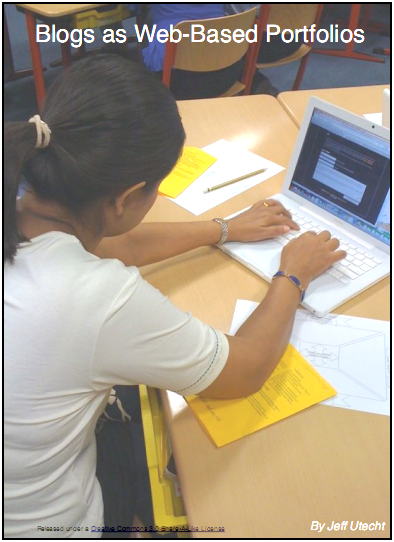
Blogs as Web-Based Portfolios
For several years now, and almost every day, I have been reading the various blogs, wikis and e-Portfolios of undergraduates, trainee teachers and students. Repeatedly I have found myself asking questions about how much guidance the students have had relating to e-Portfolios and what sort of challenges teachers or lecturers have been presenting to their students. Even the most articulate of students I find referring to a blog as their e-Portfolio.
Despite my interest in 'all things technical' I still think as a teacher and a leader of staff. To this end I would argue against the many who think that a blog or a wiki is a suitable tool for presenting an e-Portfolio. Quite simply, a good e-Portfolio is so much more. Yes, it can include blogging tools or wikis, it can include links to a whole range of Web2.0 tools, but, as Nick Rate points out (slide 15), these are all contained within the e-Portfolio. I just do not see a tool like Wordpress meeting the vast range of pedagogical activities one would expect within an e-Portfolio.
As I have repeatedly said, if the e-Portfolio is to be fully portable, learner owned and lifelong it must be hosted externally to any institution and yet, at the same time afford the security and reliability that schools require and without adding an additional workload for staff.
Thursday, 18 March 2010
Show and Tell Video
I was recently privileged to attend a 'Show and Tell' meeting presented by Christine Terry of Grays School in Newhaven (on the South Coast.) For me the overriding message was not so much about the technology but primarily that of engaging parents.
Yes, the infrastructure had to be in place. Without a good learning platform developed for even the youngest of children, without a good broadband supply, without a good policy for getting laptops in the homes, without a good understanding of the principles of the Home Access Programme, without good training of all staff including Teaching Assistants, none of this could have come about.
Not much mention is made of their use of their e-Portfolio system inbuilt within their VLE but even the youngest children know and understand words like 'transition' and have a good understanding of how the e-Portfolio can be used even at this early stage. However, the overwhelming conclusion is that the dual criteria of their whole-school strategy and the insistence of involving parents right from the start worked amazingly well.
For more on Becta's notes on the visit please click here.
For more of Becta's Case Studies please click here.
Sunday, 7 March 2010
Teachers don't know everything!
On more than one occasion when talking to a child in school I have been somewhat rebuffed by the statement, "You don't know everything!" That was always particularly hurtful as I never pretended to know everything and certainly my teaching strategy was always so ask questions and encourage my students to explore possible outcomes for themselves."A contribution which the book makes, and there is growing anticipation for this, relates to guidance on teacher readiness (including the confidence and capabilities for being aware of the suite of technologies (technological knowledge TK) for enabling a networked school community.
"In particular, the various conceptualisations which Mal Lee visualised throughout the book might be useful for parents, teachers, students to conceptualise beyond 'a place called school' to take into account access to a richer range of technologies, as well as recognise the value to parents as the first and continuing educators of their children."
Glen goes on to remind me of a quote from Dr Helen Barrett, some four years ago:
"There isn't a lot of knowledge about the pedagogical content of using portfolios for learning; the administrators and data managers are implementing electronic portfolios (that are really used as assessment management systems) with full knowledge of data and statistics but without full knowledge of the theoretical underpinnings and value of using portfolios to support student and teacher learning."
The above should disturb any reader, particularly as nothing much seems to have progressed over the last decade. Many teachers see the e-Portfolio as nothing more than an electronic CV. Few teachers use blogs for educational purposes, collaboration is still seen as nothing more than "Turn your chairs around to sit in groups and talk together about the problem." Few teachers use polling or voting software in their classrooms, very few schools permit the use of pupils' personal electronic devices and even fewer teachers know how to apply these technologies in the classroom. So if new ICTs are not being fully used in the classroom, what chance is there that teachers will encourage a Web2.0 mentality for real learning at home?
I really feel that until ITT and in-school CPD can address these issues we will not move on very far.
My response to my original title is therefore, "Yes, we don't know everything, but we should know what we need to know and also know what we don't know!"
Friday, 26 February 2010
e-Portfolios under the microscope
Jamin Lietze has produced an excellent and concise summary of his recent presentation. Well worth checking out, once one gets used to the Prezi format - best seen in Full-Screen mode.I have know of Jamin's work in New Zealand for almost two years now. A credit to his school and nation!
The details of his document on 'Set your criteria...' must be taken seriously. I hope that we can soon have an audio transcription of the presentation or perhaps an extended article as a backup to this work.
Friday, 22 January 2010
The end of the BB e-Portfolio?
A recent post from Mr Woo identified one of the weaknesses of how many young learners see the e-Portfolio. But perhaps, as other Blackboard users have commented about their difficulties in using BB in a liberated teaching & learning environment, I should not be surprised.I immediately thought of several previous posts I had written on the subject of the storage of artefacts. (see 'Ethics or common sense?' and 'Moving House?') I would not wish to say outright, "I told you so!" but I fear that in far too many cases the designers of so-called e-Portfolio systems are not thinking through the implications of their work, nor are course designers spelling out the practicalities of their strategies.
Tuesday, 12 January 2010
Do you own a Rolls Royce?
It's no good having a Rolls Royce, the latest high-performance Jaguar or a Lamborghini parked outside your house if there is no one to exploit its real potential or for its passengers to gain a wonderful enjoyment of the experience.So, too, with all the recent innovations that we are presently experiencing in schools. For some schools the Interactive Whiteboard (IWB) is such a 'white elephant' where, despite the 'oos' and 'ahs' of the visitors the actual passengers (the pupils) do not rate the experience and the driver (the teacher) has hardly gained a licence to drive the IWB! In fact, some schools are disposing of their IWBs, generally due to the lack of confidence of the driver to actually get in and try the 'brute' out. Rather than being so frustrated, I would suggest that more teachers should actually get into the driving seat of their IWB, VLE or e-Portfolio and actually begin to enjoy the experience.
I'm presently writing this post at lunchtime at the ORT International VLE Seminar week - which also happens to be an opportunity for this international audience to visit BETT. I was priveledged to present a keynote presentation on 'VLEs - Evolution or Revolution?'. The reason for mentioning this is that I have been very impressed by the clarity of thought concerning VLEs in schools. If a country like Argentina can produce really creative resources by all of its teachers then perhaps teachers in the UK had better look out. Their attitude to sharing work through Creative Commons is far more productive than the protectionist IP lobby that some feel obliged to follow.
But I really must get back to the theme of e-Portfolios and ask that we start to share good practice and, like the Argentinians, begin to develop a more creative and exciting learning environment for all our students, staff and institutions included!
Sunday, 3 January 2010
A New Year - but Old Mantras?

Although all of the above refers to CMS/LMS/VLEs etc the arguments for e-Portfolios are similar: Confusion and ignorance relating to the provenance of the e-Portfolio along with poor implemenations and even poorer teaching strategies are sufficient to encourage anyone thinking about e-Portfolios to drop the subject like a 'hot potato'.
Rather, as I have said frequently, 'Let the VLE do what it does best and allow the e-Portfolio to do what it can best do."
Tuesday, 13 October 2009
E-Portfolios in Rural Communities
Adrienne Carlson has contributed the item below. Its full title should read, 'How to Raise Awareness of E-Portfolios in Rural Communities'. Of course, we have the Home Access Programme in England but that is only the begining. Having the technology is one thing, getting both teachers and learners to use it is another, as Adrienne writes:- Introduce technology as a regular teaching tool: Since e-portfolios are linked to technology, it follows that technology must be made a teaching tool in rural communities before it can be harnessed for the purpose of e-portfolios. One way to do this is through grants and other forms of funding, but more than that, efforts have to be made to introduce teachers to technology and encourage them to use it without any hesitation. And to do this, we must teach them to use the technology with the right kind of training.
- Train teachers to use technology: Most teachers (or anyone else for that matter) who don’t have much contact with technology are usually intimated by it. They refuse to even attempt to learn it because they are scared that they will not be successful at it. Any training program should address these issues and manage the apprehensions of teachers before attempting to teach them how to use technology as a teaching aid.
- Introduce them to e-Portfolios: When teachers realize the value and usefulness of e-portfolios, they are more eager to adopt them as development tools. Programs must be held to prove to them the potential of e-Portfolios and show all staff how it can help them grow in their profession and update their skills as well.
- Understand the needs of learners: The work of Eva deLera underlines the value of making distance learning more acceptable to rural learners. Just think: no personal transport, poor public transport, little contact with other learners etc are all reasons for poor retention rates. The e-Portfolio can be the means to overcome these barriers to learning and make learning actually enjoyable.
By-line:
This guest article was written by Adrienne Carlson, who regularly writes on the topic of engineering degrees online . Adrienne welcomes your comments and questions at her email address: adrienne.carlson83@yahoo.com
Tuesday, 29 September 2009
The Advantages of E-Portfolios in Teaching
E-portfolios are beginning to gain in popularity as the entire world embraces digital technology and the online way of life, but e-portfolios still have a long way to go before their full potential is realized. For those in the dark, an e-portfolio (when used in connection with teaching) is a collection of the work of someone in the pedagogical field which reflects their ideology, their views and thoughts on teaching, a list of their accomplishments and talents, the courses and classes they teach, and so on. In short, an e-portfolio for a teacher is similar to the portfolio artists carry around in order to showcase what they’ve achieved and provide a teaser of what they’re capable of. There are various advantages in using e-portfolios when you’re a teacher: - It’s easy to update and rectify: Any data stored in a digital format is easy to maintain because you don’t have to rewrite entire documents when you make a mistake. Updating information also becomes a piece of cake because the process is almost effortless.
- It helps you become a better teacher: When you have a readymade package of all your work and your ideas and thoughts, it’s easier to analyze your style and refine your presentation when you have a plan for the future and work towards it. When you’re able to show others what you stand for as a teacher, you can prove yourself more effectively, especially when you’re aiming for a promotion.
- It proves you’re tech savvy: When you show that you’re familiar with the technology used to create and maintain an e-portfolio, you prove that you’re tech savvy, a skill that many teachers lack. In today’s world, you must know and love technology if you want to keep up with all that’s happening.
- It allows easy access to your work: When you have an e-portfolio, it’s easy to put your work online so that more people have access to it. This way, you’re showcasing your skills to a larger audience and providing yourself with appropriate exposure.
- It allows you to use multimedia: When you’re able to include pictures, videos and music in your e-portfolio, it gives it much more depth than using just text alone. E-portfolios allow you to use multimedia to your advantage and showcase your ideas and skills with much more strength.
- E-portfolios save space: No matter how much information you want to add to your e-portfolio, you can do so without worrying about space constraints. It’s easy to include information and events as they happen, because digital information is compact and concise.
E-portfolios are just becoming well-known as tools of the trade for teachers, as well as within some other sectors such as Health Care & Nursing. With more from the pedagogy field embracing them, they’re soon going to become the norm rather than the exception they are now.
By-line:
This guest article was written by Adrienne Carlson, who regularly writes on the topic of online degrees . Adrienne welcomes your comments and questions at her email address: adrienne.carlson83@yahoo.com
Thursday, 10 September 2009
The Australian ePortfolio Toolkit
In trying to under-stand the state of e-Portfolios around the world, I rediscovered the Australian ePortfolio Project Report of August 2008 that I'd neatly stored away and then forgot! As they state:"The AeP project team has developed the Australian ePortfolio Toolkit for use by ePortfolio practitioners in their institutions. The ePortfolio Toolkit comprises a series of ePortfolio Concept Guides designed to inform the diverse stakeholders in higher education about issues and opportunities associated with ePortfolio learning."
However in re-visiting their site I found it refreshing to study their 'Concept Guides'. To my mind they are one of the clearest expressions of JISC advice. However, they are just that, advice for HE and VET students, staff, technicians and employers of graduates. What we now need to do is translate these excellent documents into exemplar materials for the rest of the 90% population who are not on the HE conveyor-belt.
Excellent as the advice is, I cannot see much evidence of what is actually happening in the classroom or late at night between peers reviewing each other's work or collaborating in larger projects.
So, good as the Australian venture is, whatever nationality you belong to, please come back to me with examples of the work done in your country - and let me 'wave the flag' for your nation.
Monday, 20 July 2009
Chicken or Egg?
We have a very difficult situation concerning the introduction of e-Portfolios into the classroom. Until such time as teachers are able to free themselves from old didactic methods, until they are brave enough to let go of the reins or at least allow a bit of slack, there is very little reason to use an e-Portfolio.Unfortunately, there is also a third element with which we must contend, that of the silo-mentality of many institutions who only see the e-Portfolio as a one-purpose tool for the use of their individual institution. (see my paper, ‘Who’s Hijacking Our e-Portfolios?’)
Later on I introduced the concept of blogging, starting by using a paper-based activity. Yes, again this produced howls of laughter and a definite broadening of understanding about how others felt on the topic in question.
If teachers are comfortable with this level of freedom within the classroom, where the outcomes may be quite different to what one might have planned, and if the teacher is then able to help the students learn from the exercise, then, and only then, might we be able to demand on the grounds of curriculum enhancement the technologies we want.
Senior Leadership and Management Teams (SLMTs), as we call them in the UK, need to be convinced however that the learning will be deep learning. This needs demonstration of teacher competence in managing such scenarios as the above before the leap of faith that justifies the investment in equipment and the access to electronic collaborative tools.
Yes, blogs and wikis may be a good start but are not necessary if students have a good e-Portfolio system. As a senior head of department for many years, I would prefer to provide my teachers and their students with an e-safe system that allows the controls to be gently lifted from a totally secure or private condition through stages of group collaboration and steadily expanding the number and variety of school-based and external audiences with which any individual child is able to cope.
A good e-Portfolio, such as eFolio, provides adequate facilities to manage one’s artefacts, to use feedback from peers and mentors, to reproduce electronic versions of the collaborative activities as mentioned above and repeatedly revising one’s planning, drafting and reflections within the e-Portfolio.
In the UK I feel that most schools have been encouraged for a number of years to develop these collaborative skills either on paper or in small groups huddled around a limited number of computers. Similarly, in the UK, we have experienced over the last ten to fifteen years a large number of technological initiatives (and more still to come!) that have prepared us for the next leap of faith. But thirdly, we also have had several initiatives concerning the personalisation of learning. Again, the e-Portfolio is that special place where one’s individuality, learning styles and support by other adults lends itself to a unique repository of learning far different to the formal content delivery mechanisms of our Learning Platforms.
I would argue strongly that the UK is therefore potentially ready for e-Portfolios. However, despite my statements above, this will require a massive amount of staff training in order to help teachers understand how the e-Portfolio fits into our curriculum and can in actual fact enhance it!
BUT, this e-Portfolio explosion is not about to happen throughout the world. Many countries, even if they had the technologies and 1:1 pupil:computer ratios are still teaching in didactic, teacher-led authoritarian regimes which may not allow the individuality which an e-Portfolio supports. I suspect (and am willing to be corrected) that some parts of America are as traditional or conservative in their teaching and learning methods as mid- or eastern Europe. In other places, such as New Zealand, many teachers are already actively developing the collaborative culture upon which e-Portfolios thrive but the hierarchy are still discussing what an e-Portfolio is.
So, in returning to my original question, ‘Chicken or egg?’ I suggest that those education authorities who are most ready to introduce an e-Portfolio culture should be considering a ‘controlled explosion.’ We need all the elements of an independent learning culture, of collaboration, of an adequate sufficiency of access both within institutions and remotely through home access policies. Perhaps most fundamentally, we need a teacher education programme which can pull together all the separate benefits of an e-Portfolio for the learner.
Wednesday, 15 July 2009
21st Century Schools
Since its publication in June of this year I have struggled to understand the implications of this White Paper.It sounds good, is full of promises and some fine examples from outstanding schools. However, it seems to be propounding 'more of the same' rather than looking to new approaches. I cannot see throughout the document how 21st Century Schools will be any different to what we have NOW, nevermind in the future.
For some time now we have understood the implications of a 'flat world' and that has been developed further in Peter Bradwell's paper, 'The Edgeless University'.
I therefore see schools in a similar light. We have discussed the inestimable merits of formative assessment through the e-Portfolio many times. Along with the Home Access Programme we will soon have a near 100% on-line access for all our learners. In schools I see the 'expert' teacher not only being called upon by students in their own class, but also from other classes and other year-groups and even from other schools, 24/7/365. And why stop there? What about adult learners or collaboration with colleagues or professionals around the world? Perhaps the whole issue of contracts and conditions of service needs to be re-appriased in the light of on-line learning communities?