Add to Technorati Favorites
Showing posts with label CPD. Show all posts

Thursday, 31 March 2011

ePortfolios Australia Conference 2011

Logo of the ePortfolios Australia Conference 2011 The ePortfolios Australia Conference 2011, being held on 17-18 October in Perth, is calling for presentation proposals based on the theme Making a difference – showing the difference.

The event will provide a showcase of how e-portfolios are making a difference to adult learners from the vocational education and training, higher education and adult and community education sectors. Representatives from all education sectors are being invited to submit abstracts for full papers, case studies and posters. Abstract submissions close 18 April 2011 and should relate to one or more of the following sub-themes:

Assessment: looking at challenges, learning principles, mapping and RPL (recognition of prior learning)

Pathways and participation: looking at entry requirements, foundation courses, pre-vocational education, retention and transition.

Evidencing standards and quality assurance: looking at the Australian Quality Training Framework (AQTF), quality standards and graduate attributes.

Workforce development and graduate employability: looking at work integrated learning, continuing professional development, performance management, LLN (language, literacy and numeracy) and accreditation.

International engagement: looking at language courses, recognition, standards, migration and exchange programs and learning experiences.

Tuesday, 22 March 2011

Calling all Teachers

Photo: Two young teachers, keen and eager.If your kids have any involvement with ePortfolios, read on...

Join us at ePIC 2011, the 9th International ePortfolio and Identity Conference 11-13 July 2011, London

The conference is slowly taking shape: as usual, authors wait for the last minute to submit and many know that the deadline will be extended... However, it's you we need!

In other parts of the world, particularly the USA and NZ, many youngsters in Primary and Secondary schools are celebrating their successes through the use of various ePortfolios systems.

However, here in the UK work is going on in developing good ePortfolio practice - but is not being well published. At ePIC 2011 we want to examine further the work with ePortfolios particularly within the Primary and Secondary phases of education. But we need examples of your good practice.

I have been asked to find teachers willing to present, and attend, in order to have at least 2 sessions (6 speakers) dedicated to primary and secondary education. We can support up to 30 teachers with special discounts (and perhaps your LA/school will support you for CPD). Or your VLE/ePortfolio vendor might offer some sponsorship. (NB July might be an easier time for teachers to get 'time off' for such an important meeting.)

For further information see: http://www.epforum.eu/

PRIMARY & SECONDARY SCHOOLS
What is happening? How are ePortfolios used in Schools? Can ePortfolios overcome 'Facebook mania'? Are Parents & mentors involved? Where is the CPD? Can ePortfolios support transition? What of Interoperability? These are the questions - only you have the answers! Your involvement is imperative!

If you feel able to answer any of the above questions please offer your contribution here.
Or contact me at support@maximise-ict.co.uk

Thursday, 16 December 2010

Adult Education - The Great Divide

Book cover, A Great Gulf Fixed - A collection of the sermons by Brownlow NorthA great Victorian evangelical preacher, Brownlow North, wrote powerfully about the great spiritual divide between worldliness and Christianity. However moving his collection of sermons might be, it prompts me to think that we have a similar social, cultural and economic divide between, generally, two groups:

On the one hand are the 'youngsters' those under 30 who are generally ICT literate. Some might not think of themselves as technologically aware but they have access to all the trappings of modern society. Youngsters rarely wear a watch - instead they have a multi-function 'smart-phone'. They use all the modern digital appliances in the kitchen or lounge including a range of entertainment devices. If there are children or students in the home there will inevitably be a computer with internet access. The family car will have its sat-nav and all the modern creature-comforts digitally controlled. At school or at work, they use computers every day. They buy both goods and services on-line and represent themselves through websites or some form of blog or social software and have free access to learning, self-development and CPD. They have adopted a 'learning mindset'. They can generally be described as 'autonomous learners'.

On the other hand, there is a group of 'oldies' who are benefiting from various government and local initiatives to get on-line, to start learning how to 'catch up' with the so-called digital natives. They have the time and support, they have memories and expertises which need to be captured and shared. Homes for the elderly are fitted with all the latest safety and security gadgets, residents are supplied with personal alarms and even pace-makers. In their visits to hospital they are increasing surrounded by astoundingly expensive X-ray machines and body scanners. Increasingly we find in homes for the elderly all the latest digital equipment, computers and large-screen projectors. Care staff are encouraged to provide interesting activities for the elderly, infirm or those who have some form of disability. In general they are getting personal and appropriate support according to their needs.

But, there is a GULF FIXED for those who fall between these two groups. This intermediate group is composed generally of those who are in work, 'looking for work' or caring for children but with little chance of self improvement. At this time of economic crisis they are insecure and with little ability or awareness of how to bridge the gap - to start learning by themselves or to get the support that they need. The UK has often been called 'a nation of shopkeepers' - yes small businesses where people are working hard, but standing still. They work 'noses-to-the-grindstone' and are not aware of how others are looking after themselves. CPD is an unknown word in their vocabulary. Many of these people fall into the 'Level 1, Level 2 categories' as described by Leitch. Smaller companies do not have 'Human Resource Departments', they do not have HR managers. Their employees are not able to 'bootstrap' themselves into being more able workers. Many do not have Trades Union support or belong to Professional Associations. In terms of self-improvement, they are trapped in a 'gulf of inability'.

At a recent meeting in the North East of some 80+ senior leaders and education managers organised by NIACE this problem really struck home to me. It is this massive group of unsupported workers that need the targetted help of organisations such as NIACE. Of the several strong and clear messages that came out of this meeting was the whole concept of Partnership. Not of many small partnerships, for instance, of a local employer and a local school or college. Not even of a local district uniting a consortium of employers, schools and colleges. What we need is the BIG PICTURE of a locality (or region?) as big as the North East where all providers of learning, all careers services and employers become one large partnership. Such a group would need to show a lot of respect for each other, all around one 'round table'.

But how does the above Big Partnership help those trapped in the Gulf between autonomous learners and those benefitting from personal support. I believe that, with the benefits of on-line information services, the available skills and training needs can be plotted for a whole region; that larger organisations, with their staff development expertise, should be providing 'open house' to those smaller companies who, as described above, do not have such facilities for their personnel. Such consortia or partnerships are working well in the Netherlands, so why not here?

Adult education is therefore at a cross-roads. It can continue to provide 'more-of-the-same' to a dispirited workforce and dispirited employers. Or, Adult Education can pull together a Partnership of both the wider range of expertise(s?) within separate organisations, pull together a broader range of learners, pull together a wider range of training organisations and actually get to grips with the challenges laid down by Leitch so many years ago. Colleges, in particular, need to understand something of 'The Joy of e-Learning' as described by Eva de Lera several years ago. Learners, 'trapped at the grindstone', need to be supported by employers who can see that their companies will become more productive, loyal and retentive by upskilling their workers.

Obviously organisations such as NIACE should be in the vanguard of promoting Partnerships which not only enhance current provision but also they must address the wishlist of Leitch and 'get to the parts that others cannot reach' ie, those who are trapped in this gulf of inability.

But why have I gone to the trouble of describing this scenario in such detail? It is simply that I believe that the ePortfolio is the perfect low-cost tool which will enable this underclass of potential learners to share their achievments with others, to have access to personal mentoring and discover and communicate their self-worth.

There is no reason why mobility of labour should be available only to the upper echelons of society. Autonomous learning should be free to all. And it is the ePortfolio that can make this happen.

Saturday, 13 November 2010

Reflecting on Reflections

Photo: A myriad stars within our galaxyI have written several times about the value of the ePortfolio as a tool to aid reflection (see tags list for 'reflection'.) However, in a recent post Karen Barnstable writes very clearly on the value of reflection, but more than that, adds some helpful advice on how to think through and document reflection with a 4-point STAR - well worth reading.

As I commented on Karen's post, the compilation of a separate 'diary' of reflections might be a very effective CPD tool for anyone. As Dr Helen Barrett suggests, the ePortfolio lends itself to recording one's 'Life Story'. I just wonder how many myriads of reflections or evaluations I have composed and then forgotten. What would I think about my own life-story if I had retained those reflections for further reflection?
Memory Jogger:
S - Situation
T - Task
A - Action
R - Result
But please read Karen's post to see this in context.

Thursday, 11 November 2010

A few questions...


Well, the full title should be, A few questions before you launch into implementing ePortfolios at your education institution.
Graphic: doll outlines: people asking questions

For some time now, I have been following the adventures of Sarah Stewart and her application of ePortfolios to the work of midwives in New Zealand and Australia. Recently she posted some 10 questions which potential implementers of ePortfolios should ask themselves before taking such a leap of faith. With her permission I have duplicated her questions and provided some answers:

1. What are you wanting to achieve?
Does an ePortfolio system allow you to achieve that aim or would something else be more appropriate? For example, you would like to use an ePortfolio to allow a seamless submission of assignments by students...do you need an ePortfolio to do this, or can you achieve that function via your current learning/student management system?

Answer:
Any half-legitimate institution for teaching and learning should have its own VLE with a good range of resources including rubrics, rich media, archived materials, and powerful tools much broader than the standard syllabus in order to allow students to develop their own personalised learning environment. So, what we should be doing is looking at those aspects of an ePortfolio that a VLE cannot easily deliver.

2. Is what you are wanting to achieve pedagogically sound?
In other words, do you have a sound educational reason for implementing ePortfolio or are you attracted by the technology with all the latest bells and whistles?

Answer:
Introducing an ePortfolio system will not suddenly change teaching and learning strategies. Rather, a student-focussed approach should inevitably suggest that an ePortfolio is the best medium to manage a range of learning activities where peer-review, feedback in all its forms, use of alternative media, supplementary information about students etc is possible. Above all the ePortfolio should allow the ability to present selected artefacts to a variety of audiences, under controlled access.

3. What is the evidence about ePortfolio in your context?
Is there solid evidence that ePortfolio makes a difference to students' learning or is ePortfolio another fad you are following for the sake of it?

Answer:
There is a growing body of evidence from both students, teachers and administrative staff that ePortfolios have a demonstrable impact on both teaching and learning. However, this takes time for new-start institutions. It takes several years for most institutions to settle down to ePortfolio thinking. Until teachers have discovered what works/does not work for them, until exemplar materials related to ePortfolio processes are tried and tested, until an institution has a good body of alumni who understand ePortfolios, until a good cohort of mentors can advise from their own previous experiences, that evidence will be slow to materialise. Administrators, too, have noticed a significant increase in retention rates.

4. What ePortfolio tools best suit your students' needs?
Before you sign off on an expensive proprietary ePortfolio platform, is there an online tool already available that will better suit your students' needs? For instance, if you want your business students to be prepared to find a job, would they be better off developing a LinkedIn account? Would your carpentry students be better off uploading photos of their work to Flickr? Would a blog suit students' needs for a reflective ePortfolio?

Answer:
This question suggests a restrictive view of teaching and learning. All students should have access to a wide range of tools, such as they prefer to work with, such as Flickr, Prezie, PhotoPeach, Issuu or Audacity to name just a few. But these are NOT ePortfolio tools as such. ePortfolio tools consist of facilities such as making individual artefacts private, shareable or public. Tools such as polls, surveys or Likart scales as well as pre-set forms which can be ‘switched’ on or off all allow different methods of providing feedback. Similarly, blogs or wikis can be contained within the ePortfolio so as to create a private but collaborative community where students can work together with some confidence that their efforts and mistakes will not be seen by ‘outsiders’. - Anyway, who says a proprietary system has to be expensive? - eFolio certainly is not!

5. Who is in control of the ePortfolio?
If you dictate the ePortfolio to the students they are far less likely to engage with it than if they have total control over it. The ePortfolio must belong totally to the students so it can be developed to meet their needs, as opposed to your needs as lecturer and that of the institution.

Answer:
In many cases it might be better for the institution to provide the ePortfolio with some level of scaffolding to help students get off to a good start rather than having to build from a blank canvas. A range of good support features will enable the student to identify what things can be changed immediately and what things can be modified at a later date. It is up to the teacher to decide how much ePortfolio support each student may need, but, as when encouraging a baby to walk, there comes a time when hand-holding is not necessary. Control is a matter of gradual release.

6. Will the ePortfolio be integrated into the curriculum?
If the ePortfolio is an extra add-on to the students' work, they are unlikely to engage with it. Thus, you need to consider how you will integrate it into the curriculum and assessment. This may require a lot of work for faculty staff, so you have to decide if this effort is "worth it".

Answer:
This might create a bit of strain for those educators who have not made the transition to collaborative teaching and learning. However, having access 24/7 to a student’s ePortfolio means that monitoring progress is easier, particularly if you have a few students who need ‘prodding’ to get going. Similarly early intervention if a student is beginning to veer off course actually saves the teacher considerable work when students begin to get towards the date of submission. As mentioned previously, this can help retention rates.

7. How portable will the ePortfolio be?
What will happen to the ePortfolio when the students leave the institution? Portability is one argument for using the cloud such as Google Apps, as opposed to a platform that is restricted to student use only.

Answer:
Portability is a fundamental question and although questions about teaching and learning MUST come first, the issue of portability will actually influence teaching and learning strategies. I have heard too many HE students say “Why should I bother, I can’t take it with me!” If the ePortfolio is to be both Lifelong and Lifewide it MUST be capable of full portability without the destructive influences of extant interoperability systems. However, the rush to use cloud solutions is not without its drawbacks. A secure externally hosted system provides the best of both worlds. eFolio, for instance, is hosted externally in the UK and Europe. One of the significant drawbacks of a cloud-based solution is that of the lack of educational support whereas eFolio is provided primarily as a tool for learners.

8. Can the ePortfolio be integrated into the students' life as a professional tool once they have left university/college?
This is an especially important question for nurses and midwives who are required to have an ePortfolio as part of their statuary requirements for practice. There's little point in developing an ePortfolio platform that is different from one they will use once they are qualified. On the other hand, is this an opportunity to collaborate with hospitals and professional bodies to ensure there is a seamless integration of ePortfolio from life as a student into professional practice?

Answer:
Yes, it is ESSENTIAL that the principle of the ePortfolio as being Lifelong should enable the newly qualified professional, for instance, to use the ePortfolio for the continuation of one’s career and other interests and to share with new colleagues etc. In a new situation, the cosmetic display and layout of pages, the selection of relevant artefacts should be capable of matching one’s new image.

9. How will you evaluate the ePortfolio?
You must have a process for measuring the impact of the ePortfolio as opposed to implementing it without further follow up.

Answer:
Perhaps the most significant feature of evaluation is not that of the presentation of the ePortfolio nor of the artefacts contained within it and the temptation to think summatively, but rather to look at the reflections, the benefits of collaboration and the learning processes the student experienced that demonstrate an increased maturity of understanding rather than just a completed project.

10. Do you walk the talk?
Do you have an ePortfolio that models the process to both colleagues and students? How can you know the value of a pedagogical process if you do not engage with it yourself?

Answer:
Yes, every teacher is a learner, a collaborator, and, where necessary a bit of an exhibitionist. The ePortfolio should be seen as a tool for learners, teachers, departments and institutions. The same tool can be used for many different purposes and all sections of society.

Friday, 5 November 2010

Escaping the Stone Age - II

Screenshot of Sarah Stewart's SlideShareClick above to see the SlideShare


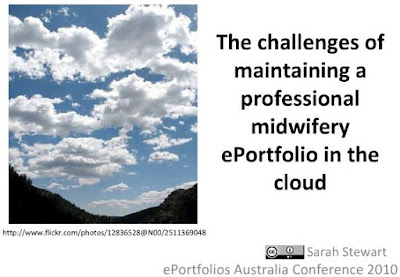
I have been following the progress of Sarah Stewart's work, exploring how the ePortfolio can serve the midwifery service in Australia. Her presentation, as indicated above, is a valuable consideration of the problems involved in introducing ePortfolio thinking into any community.

However, many of her 'frustrations' follow on from my previous post, that of overcoming 'Stone Age thinking'.

Perhaps one of the first issues to overcome is that of the technology. If it looks complicated then it IS complicated. For adults who are not as IT savvy as they could be, and have plenty of other things on their minds, it is essential that whatever ePortfolio system they choose, it should be 'childsplay'. It should be easy to use and immediately attractive.

Secondly, Sarah's presentation illustrates the generation gap in ePortfolio thinking. It was not only the midwives who found difficulty in adopting ePortfolios, it was the assessors and administrators who were at least reticent if not downright reluctant. It is time that governments recognised this situation and sponsored urgent adult training in ICT for all generations - and particularly for services, such as midwifery, that require portfolios.

Yes, the lack of equipment, of resources and of broadband availability needs to be recognised - and it may be some time before much of Australia gets the service it deserves!

However, speaking as an experienced teacher, it would appear that Education Authorities must reflect upon their own consciences and ensure that the upcoming generation is properly and speedily trained as the 'net generation. One thing that we have learnt here in the UK is that by ensuring that our children have good 'Home Access' that their parents, carers and even grandparents are having to learn ePortfolio thinking.

Saturday, 2 October 2010

Eportfolios for Lifelong Learning and Assessment

Darren Cambridge's latest book is not meant to be an easy read but, as far as academic books go, Darren has made a detailed and wide ranging study quite addictive. He writes authoritatively and, what's more, each chapter is full of up-to-date examples of case-studies and a real understanding of the new approach to teaching and learning.

Despite writing primarily for the higher echelons of academia, much of what he writes about can equally be applied to all levels of teaching and learning:

"Lifelong learning is an ongoing process of developing knowledge, skills and strategies; putting capabilities and self-understanding into action over time; and thereby establishing an identity. To support lifelong learning, higher education needs to look beyond the content knowledge, practical techniques, and professional capabilities that have been its primary focus. Colleges and universities need to commit to helping students craft identities that reflect their own values and equip students to put that self-understanding to work in their communities and the rest of the world."

At €39.36 the e-book is not cheap and the format does not easily lend itself to the annotations and hyperlinks I usually like to add to a document that I am studying. For further details click here. However, that one slight grumble off my chest, I found the book to be informative, challenging and quite encouraging. Further to Darren's comment, (see comments below) check out the Amazon pre-order offer, click here. UPDATE (13 Oct): The book in hardcover format is now available direct from Wiley at £26.99 (much better value for money!)

One last quotation must suffice which exemplifies Cambridge's clear sense of the convergence of teaching and learning, the wider world, present technological developments and the place that ePortfolios must take:

"Rather than simply supporting their students ’ learning, colleges and universities should put their expertise and infrastructures to work in partnership with other institutions — schools, employers, government agencies, community service organizations — to improve the quality of learning in the many distributed contexts in which it must occur for individuals to prosper in our rapidly changing world. Through helping individuals articulate their distinctive identities in order to chart the paths of their learning and influence the shape of the institutions in which they learn, eportfolios have a central role to play in the learning society that higher education can help bring into being."

Wednesday, 15 September 2010

And now for something different


I thought that, for a change, I would show this montage put together using PhotoPeach. Not that I am getting any commission.

Tuesday, 7 September 2010

Lynne Groves and Trent Batson at Collab Tech 2010

Photo:  Lynne Groves and Trent BatsonA useful video by Lynne Groves of eFolioWorld and Trent Batson of AAEEBL recorded at Collab Tech 2010. This is a practical discussion of ePortfolio pedagogies and processes. Please click the graphic to see the YouTube presentation. Both speakers emphasise the point that teaching must change, not because of the ePortfolio so much but rather that the ePortfolio allows both teachers and students to better perform unshackled by the traditional classroom environment.

Only one minor point of disagreement with Trent Batson, where he suggests that institutions might want to use different ePortfolios for different purposes. NO! The whole point of eFolio (which he missed) is that eFolio can be used for a variety of different purposes, showing to different audiences different views or personas of the learner.

Saturday, 4 September 2010

E-Portfolios: The Joys of Disruption

Snapshot from the Quinnipiac conference Darren Cambridge is a well known voice in the ePortfolio world and has authored or co-authored several helpful books. The YouTube Recording, of his presentation on 23rd August, at one 1hr and 40 mins takes some dedication to follow - I just feel for the people in the audience! What he said was good if not new to many who regularly read this blog.

Early on in his presentation Darren claimed that ePortfolios evolved from paper-based 'Writing Programs' and the need to teach writing skills in the 80's. This flies in the face of the work of Dr Helen Barrett and her identification of portfolio practice based on young children's 'shoeboxes' in the 70's or my own experience of presenting portfolios of work in the 60's for Design and Technology courses.

The presentation was frank and at times honestly brutal in terms of the 'extra' work that staff would need to undertake. What he did not mention, as far as I could detect, was the fact that the ePortfolio system actually helps staff to save time: having access when convenient, being able to provide feedback before a student might find himself 'up a blind alley', being able to quickly route to areas of particular interest, etc. On the other hand, Darren did point out the fact that the ePortfolio allows teachers to see the whole picture of the learner, their interests and background.

As a 'stand alone' presentation I just felt that he presented too many negatives. However, within the context of a larger workshop conference I hope that delegates found more things that excited them and where they could see how the ePortfolio can actually enhance Teaching and Learning.

The term ‘Disruptive Technology’ is only true where it is an indictment of outmoded pedagogies. For institutions that have emerged from the dark ages and have been using Web2.0 technologies and liberated Teaching & Learning styles the introduction of an ePortfolio facility could rather be seen as an ‘answer to a maiden’s prayer’. I’m trying to think of the best antonym to ‘disruptive’ – we need a word that combines supportive, energising, and challenging or provocative.

Thursday, 26 August 2010

Student-Centered Learning: Target or Locus for Universities?

Trent Batson always writes both eloquent and very relevant articles and this is no exception. I quote but three brief paragraphs from a very challenging post:


"Student-centered learning has been largely a rhetorical distinction for decades - e.g., more group work or less group work - because, practically speaking, everything happened in the classroom. But now, student-centered learning has, as a concept, particularly in the past five years, come to encompass a vastly wider variety of choices, about how to design and plan for it.

"Now, the distinction is not just rhetorical, but a life style distinction: scarcity learning (content delivery) in the classroom or abundance learning (discovery) often out in real-world situations. In scarcity learning, the student is the target for delivery systems, while in abundance learning the student is the locus, the starting point, of learning.

"Higher education has unwittingly chosen to use the very technologies that have changed our broader economy to resist change in education. In the free market, in society, people are choosing to use technology inventively and boldly, but in the controlled market of the academy, administrators limit the technology options and proceed without imagination or courage, except in rare cases."

The points that Trent identifies have worried me for over a decade now. My son left High-School at the age of 16 with 11 good GCSE grades hoping to do even better at College. Unfortunately he found the lecturers dull and in his estimation not always competent in their subjects. The textbooks that he was supposed to work from were generally out of date (and expensive) and the coursework moronically boring. Invariably, in his Computing classes, he found himself supporting other learners rather than extending his own competencies. It was not long before he left in disgust.

My concern at that time was simple: "Why should we encourage our pupils to be bright enquiring collaborative learners if all their new learning skills were to be 'rubbished' by the colleges and universities?"

Fourteen years later it would appear that the same scenario still exists. Trent's conclusions need careful contemplation - and application, not only in HE but also in mainstream education.

Friday, 30 July 2010

ePortfolios – still trialling? Why?

Graphic: Jigsaw piecesDarren Lott recently raised the above question in his blog. Funnily enough, the questions that he raises are very similar to the issues that I tried to address at both the EIfEL and AAEEBL conferences earlier this month.

However, Darren's enthusiasm for wanting to get going highlights a recurring issue, that of individual organisations 'doing their own thing'. It is essential that if a true Lifelong and Lifewide ePortfolio is to continue throughout life, 'From cradle to grave' then the practicalities of how that ePortfolio can evolve with the maturing lifestyle and interests of the learner need to be explored.

Firstly, all of the ePortfolio 'pages', the welcome page in particular, should be capable of repeated re-formatting with appropriate graphics, colour schemes, fonts and widgets etc. As I have said before, the immediate impact that an 11yr-old (or even a 5yr-old) may wish to convey will be quite different to that of a young professional trying to get on in the world. It is similarly true for the teenager whose overriding passion is for a particular football team or pop group - and what happens when they change their loyalties?

Secondly, and following on from the first point, I believe that a good ePortfolio should be capable of presenting different views or 'personas' to different audiences. Using the one ePortfolio and dipping into a common set of artefacts, which have been stored once, the owner can represent him/herself in different ways to different audiences. How I represent myself to my pupils at school or to my professional colleagues, to my church group or to a charitable organisation might all be very different. Should I therefore be using four or more different ePortfolios in order to present each persona?

Thirdly, as I have said many times before, the ePortfolio is Learner Owned. It is appreciated that initially the ePortfolio may be provided by an institution and even fitted out with some appropriate level of scaffolding. However, like an exercise book, once the learner has used the exercise book, or decided to use a ring-file etc, it inherently becomes the property of the learner and is kept for perpetuity. (How many of us still have some of our old exercise books stored away in the attic?)

Fourthly, the question of 'transition' must be addressed. One of the reasons for so many pilots and reports of mixed feelings towards adoption arises when the student leaves their school or college to join another academic institution. It is a common experience that the 'new' school will have a different ePortfolio system. They get to the new institution only to find that the promised 'interoperability' does not deliver the student's anticipated ePortfolio intact but rather find it 'broken' into a number of separate files, some unrecogniseable. The student is then faced with the unenviable task of having to re-build their lovingly crafted ePortfolio all over again. I can just imagine the feelings of rebellion that some of my more rebellious teenagers or 'neets' would think! But even worse still, what would happen to the child's work when moving from Primary school to Secondary school? Who would do the exporting and who would do the importing? Who would do the re-building and having to learn a new ePortfolio system?

Following on from the above is the slightly different aspect of 'portability', ie where the learner has possession of their ePortfolio and wishes to show it to others. Many institutions are not willing to host their alumnis' ePortfolios for perpetuity and thus the whole arguments concerning PDP and showcasing fall down. Many graduates, for instance, may not move seemlesly from University straight into employment, they may choose a 'gap-year' or take on some part-time work whilst they get their social life sorted out. Others may be 'between jobs' for a considerable period of time - all when they might want to work on their ePortfolios but not be part of an academic institution willing to host their work. Please see the example of an eFolio student who graduated several years ago. Her eFolio remains intact and up-to-date as it is hosted externally to any institution and certainly external to her present place of work. It is completely 'mobile' and is accessible from anywhere in the world.

Finally, there is the whole question of Assessment. There are a number of good assessment tools that work very well when attached to the MIS of the VLE or LMS - and that, in my opinion is where they should be kept. Unfortuanately there has become established a tradition that particular subject-specific training organisations provide their students with an on-line learning pack which is a combination of a course management tool, a personal log, a collaboration tool, a sophisticated testing and assessment tool, all rolled into one and called an 'ePortfolio'. Such a tool is hardly 'learner owned' and has little value as a showcasing or reflection tool for lifelong learning.

So, in response to Darren's enthusiasm, I would suggest that we look more carefully at the long-term expectations one may have of an ePortfolio before committing to a product which is bound to fail several criteria.

Thursday, 1 July 2010

Social Networking & e-Portfolios

I enjoyed this article on Social Networking, in the Learning Solutions Magazine (5th of a very interesting series). Although unrelated directly to e-Portfolios, Ann Derryberry eloquently draws out some very clear principles that apply equally to working with e-Portfolios.

As she says in her prepenultimate paragraph:

"The existence of a well-conceived and -implemented social learning platform does not in and of itself lead to a thriving social learning community. If participants do not quickly see the utility of their involvement, or if they can’t recognize a return on their engagement, they will quickly drop out. A clear articulation of purpose, easy access for all participants, a meaningful incentive system, and allowance for casual interaction among participants are key factors to a social learning network’s success."


These, surely, are the same prerequisites one would expect for an e-Portfolio? At a time when researchers are asking this very question of "How can we ensure 'buy-in' of our e-Portfolio system?" the fundamental issue is that of the vision of the teacher to realise that the e-Portfolio will support the teaching and learning strategies of the modern classroom - and to realise that e-Portfolio learning must embrace social learning but can also deliver it in an e-safe and documented way.

Wednesday, 16 June 2010

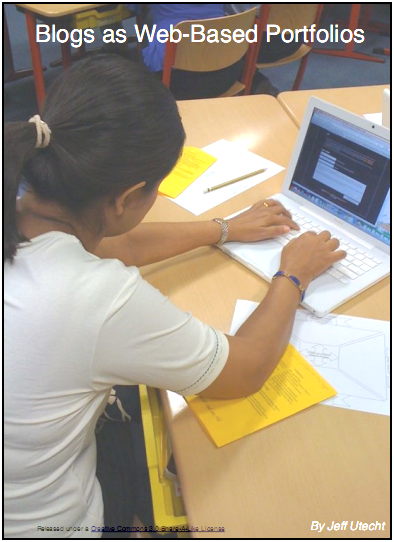
Blogs as Web-Based Portfolios

Photo: child blogging on a laptopI pounced upon this free book (13 pages) by Jeff Utecht as soon as I saw the title, 'Blogs as Web-Based Portfolios' for two reasons. Firstly, because I found Jeff's easy to read style to be quite fascinating (I have referred to this in my previous post) . However, unfortunately, my second reason for it grabbing my attention was that the title was like a red rag to a bull - and thus for this post!

For several years now, and almost every day, I have been reading the various blogs, wikis and e-Portfolios of undergraduates, trainee teachers and students. Repeatedly I have found myself asking questions about how much guidance the students have had relating to e-Portfolios and what sort of challenges teachers or lecturers have been presenting to their students. Even the most articulate of students I find referring to a blog as their e-Portfolio.

Despite my interest in 'all things technical' I still think as a teacher and a leader of staff. To this end I would argue against the many who think that a blog or a wiki is a suitable tool for presenting an e-Portfolio. Quite simply, a good e-Portfolio is so much more. Yes, it can include blogging tools or wikis, it can include links to a whole range of Web2.0 tools, but, as Nick Rate points out (slide 15), these are all contained within the e-Portfolio. I just do not see a tool like Wordpress meeting the vast range of pedagogical activities one would expect within an e-Portfolio.

As I have repeatedly said, if the e-Portfolio is to be fully portable, learner owned and lifelong it must be hosted externally to any institution and yet, at the same time afford the security and reliability that schools require and without adding an additional workload for staff.

Building Communities and Networks

Book cover: a hand reaching upwards to the lightI am very grateful to Jeff Utecht for releasing as a free copy, his book 'REACH - Building Communities and Networks for Professional Development'. The book is easy to read and is an excellent introduction to what the 'C' in ICT is all about. I would think that the book could easily be used as a pre-reader for a staff development day or series of workshops. My only wish was that this book could have been available some ten years ago!

Although the word 'e-Portfolio' is strangely not mentioned in the book, the whole mind-set that Utecht describes is that of the e-Portfolio user. It is not surprising, therefore, that he has written another book, 'Blogs as Web-Based Portfolios'.

Tuesday, 15 June 2010

Nick Rate on e-Portfolios

I have long appreciated the thoughtful and challenging work of Nick Rate, no more than in this Slideshare. It is worth going to his blog post for some further questioning thoughts.

Much of what he writes makes for very good pedagogy although he raises several questions which we at eFolio in the UK believe we have the answers. One typical 'error' in my way of thinking, is to consider an e-Portfolio as a tool for Assessment OR a tool for recording Process(es) OR a tool for Showcasing. In eFolio it is quite possible for the one e-Portfolio to be used for all three (and more) functions at the same time. This can be done as soon as one understand the principle of writing for a specific 'Audience'. In eFolio artefacts can be uploaded once and yet repurposed according to the 'view' presented to specific readers.

Again, Nick raises issues of ownership and portability which need to be resolved by each individual school. Unfortunately, he leaves these questions unanswered, and, until they are, schools cannot really start on a track that they might regret later. eFolio has been purposely designed to overcome the questions that Nick leaves unanswered.

Well, apart from my gripes, New Zealand should be very proud of the work of such energetic leaders!

Monday, 14 June 2010

e-Portfolios in Primary schools?

Photo from Dreamstime.com Primary classroomI was recently asked the questions, "How do I start using e-Portfolios in a Primary school?" - An important question that needs a serious answer. But, in simple terms, as with much of education, my answer is simply, "Start with the known and move to the unknown."

eFolio is exceptionally configurable to the needs of even the youngest children - a simple clear layout, in easy English, inviting the youngsters to take ownership of their eFolios right from the start. At this stage it should be noted that the eFolio is set by their age to be a private account and is not discoverable by search engines.

In discussion with eFolio staff, the teacher can decide what template, font styles and page tabs should be set as the default profile along with any scaffolding.

To begin with, say in yr5, it might be that only one task per term is asked for, and children find it very easy to start off with a topic such as 'All about ME!' Once the children are comfortably working at this writing task, it might be that the teacher asks the children if they have a digital photograph at home that they would like to use in their eFolio. This then becomes a great opportunity to get parents/carers involved. The teacher, at this stage, will have to enable access for the parents who can then assist in uploading an appropriate image to their eFolio. (removing the task from the teacher!)

Perhaps, in the next term, children could be asked to write about 'My favourite school subject(s)'. This, as with the previous topic, allows not only the teacher to understand more about each individual child and their backgrounds but also begins to help parents have a better insight as to their child(ren)'s learning.

Thirdly, children begin to develop their own identity through working on a further page, 'My hobbies and clubs'. By this time the children will have begun to develop their own self-identity within their eFolio and could be encouraged to allow two or three of their closest friends to have access to each other's sites. This will enable formative feedback, polls, surveys, Likart scales or peer review and thus stimulating the documentation of discussions often left uncaptured in the normal classroom environment.

In yr6 it might be that teachers want to start encouraging children to think about transition to 'the big school'. An enduring theme can start with the title, 'In the Future' - which could be as imaginative as the teacher wants. The student may change this title at a later date to 'When I grow up', and even later, 'My Career plans'. Apart from anything else, this begins to establish the concept of the e-Portfolio as being an ever-living, lifelong and ever changing document.

Another useful page could be, 'My awards and honours' which begins to document any credentials that the student feels are applicable. This might encourage the use of scanned images or additional photographs. I have found this particularly useful when interviewing children before their transition to Secondary school. In later years this section will provide links to the Learning Records Service (ex MIAP).

Well, that's the short version of my answer to what I call the evolution of an eFolio! For some more examples of this evolution, see: www.maximise-ict.co.uk/eFolio-01.htm

Saturday, 5 June 2010

The Blind Leading the Blind?

Dreamstime Photo: Being welcomed by a blindfolded man.As an avid e-Portfolio watcher I spend hours every day reading students' e-Portfolios and academic articles, from the most naive to the extremely erudite. However, what was exciting some four years ago has made me become increasingly frustrated as I repeatedly read the same sort of academic papers describing small-scale 'Pilots' which never seem to get anywhere. Similarly, students from all around the world write of their requirements to explore, investigate or design e-Portfolios as an ICT competency excercise imposed upon them by their tutors.

This set me thinking: Why is it that apparently intelligent people, tutors or faculty in particular, appear to lack any reasonable knowledge of the full functionality or benefits of using an e-Portfolio system?

After some 20 years of e-Portfolio thinking it seems strange that so many school leaders have no working familiarity with the tool. If students can benefit so much from e-Portfolios, what confidence can they have in faculty who don't use them. What sort of duplicity is it that says, 'You must do this, but I don't.'

Perhaps one might ask, 'Who blindfolded you?' Is it the institution that says this would cost too much to implement? Is it faculty who say we haven't got the time? Is it educators who have not adopted Web2.0 thinking? Have staff been confused by misleading advocacy? Or is it an hierarchy that intend maintaining the status quo?

Perhaps nearer the truth is the fact that many students can see through the weaknesses of a profession that relies on orthodoxy rather than exploring a brave and exciting new world of Teaching & Learning?

As I have said in several other places, 'Without a vision the people perish!' No where is this more true than in the world of e-Portfolios. Let us therefore stop all 'Pilots' and get involved in implementing whole-school policies for e-Portfolios, NOW!

Thursday, 6 May 2010

Reasons why our graduates need an e-Portfolio

Photo: Graduate celebrating with her Diploma (from Karen's Blog)I always enjoy reading Karen Barnstable's blog. She lists three very clear reasons for graduates taking their e-Portfolio with them once they have left uni and found employment, moved on to further study, or still job-hunting.

However, I would add a fourth point, assuming that you have a good e-Portfolio system. When introducing an e-Portfolio to novices in your new-found place of work it could be a bit overwhelming if the essential tools for collaboration, peer review, mentoring etc are not in place within the e-Portfolio system and need to be found elsewhere. And what of on-line help? Does the system provide support for the new user?

If the adult novice can be introduced to an e-Portfolio system such as eFolio all the feedback tools, templates and formatting menus are together in an integrated system designed for both Lifelong and Lifewide Learning and Leisure. What's more, because eFolio is designed by educationists to provide the support for learners of all ages, from 5-95, (and even younger) support is always at hand.

Friday, 23 April 2010

ePortfolio CDL Conference April 24 2010

Screenshot from the presentationThe presentation by Mara Kaufman and Nazik Roufaiel at the ePortfolio CDL Conference April 24 2010 is attractive to look at and appears to be generally well researched. I was particularly impressed with several of the graphics including the one above.

However, as usual, it would have been helpful to see real examples of e-Portfolios produced by their students. I would have loved to be a 'fly on the wall' at their conference just to see audience reaction and to hear some of the comments related to the slides. I do hope that there will be an audio recording or a transcription of proceedings!
Perhaps my chief observation is that this presentation again reflect the efforts of an individual institution to reinvent the e-Portfolio. Is it not time that instead of talking about e-Portfolios we actually got down to using them in ALL of our institutions. Is it not time that we accepted that the e-Portfolio should be learner owned and completely portable from one institution to another and truly Lifelong?