Add to Technorati Favorites
Showing posts with label training. Show all posts

Thursday, 16 December 2010

Adult Education - The Great Divide

Book cover, A Great Gulf Fixed - A collection of the sermons by Brownlow NorthA great Victorian evangelical preacher, Brownlow North, wrote powerfully about the great spiritual divide between worldliness and Christianity. However moving his collection of sermons might be, it prompts me to think that we have a similar social, cultural and economic divide between, generally, two groups:

On the one hand are the 'youngsters' those under 30 who are generally ICT literate. Some might not think of themselves as technologically aware but they have access to all the trappings of modern society. Youngsters rarely wear a watch - instead they have a multi-function 'smart-phone'. They use all the modern digital appliances in the kitchen or lounge including a range of entertainment devices. If there are children or students in the home there will inevitably be a computer with internet access. The family car will have its sat-nav and all the modern creature-comforts digitally controlled. At school or at work, they use computers every day. They buy both goods and services on-line and represent themselves through websites or some form of blog or social software and have free access to learning, self-development and CPD. They have adopted a 'learning mindset'. They can generally be described as 'autonomous learners'.

On the other hand, there is a group of 'oldies' who are benefiting from various government and local initiatives to get on-line, to start learning how to 'catch up' with the so-called digital natives. They have the time and support, they have memories and expertises which need to be captured and shared. Homes for the elderly are fitted with all the latest safety and security gadgets, residents are supplied with personal alarms and even pace-makers. In their visits to hospital they are increasing surrounded by astoundingly expensive X-ray machines and body scanners. Increasingly we find in homes for the elderly all the latest digital equipment, computers and large-screen projectors. Care staff are encouraged to provide interesting activities for the elderly, infirm or those who have some form of disability. In general they are getting personal and appropriate support according to their needs.

But, there is a GULF FIXED for those who fall between these two groups. This intermediate group is composed generally of those who are in work, 'looking for work' or caring for children but with little chance of self improvement. At this time of economic crisis they are insecure and with little ability or awareness of how to bridge the gap - to start learning by themselves or to get the support that they need. The UK has often been called 'a nation of shopkeepers' - yes small businesses where people are working hard, but standing still. They work 'noses-to-the-grindstone' and are not aware of how others are looking after themselves. CPD is an unknown word in their vocabulary. Many of these people fall into the 'Level 1, Level 2 categories' as described by Leitch. Smaller companies do not have 'Human Resource Departments', they do not have HR managers. Their employees are not able to 'bootstrap' themselves into being more able workers. Many do not have Trades Union support or belong to Professional Associations. In terms of self-improvement, they are trapped in a 'gulf of inability'.

At a recent meeting in the North East of some 80+ senior leaders and education managers organised by NIACE this problem really struck home to me. It is this massive group of unsupported workers that need the targetted help of organisations such as NIACE. Of the several strong and clear messages that came out of this meeting was the whole concept of Partnership. Not of many small partnerships, for instance, of a local employer and a local school or college. Not even of a local district uniting a consortium of employers, schools and colleges. What we need is the BIG PICTURE of a locality (or region?) as big as the North East where all providers of learning, all careers services and employers become one large partnership. Such a group would need to show a lot of respect for each other, all around one 'round table'.

But how does the above Big Partnership help those trapped in the Gulf between autonomous learners and those benefitting from personal support. I believe that, with the benefits of on-line information services, the available skills and training needs can be plotted for a whole region; that larger organisations, with their staff development expertise, should be providing 'open house' to those smaller companies who, as described above, do not have such facilities for their personnel. Such consortia or partnerships are working well in the Netherlands, so why not here?

Adult education is therefore at a cross-roads. It can continue to provide 'more-of-the-same' to a dispirited workforce and dispirited employers. Or, Adult Education can pull together a Partnership of both the wider range of expertise(s?) within separate organisations, pull together a broader range of learners, pull together a wider range of training organisations and actually get to grips with the challenges laid down by Leitch so many years ago. Colleges, in particular, need to understand something of 'The Joy of e-Learning' as described by Eva de Lera several years ago. Learners, 'trapped at the grindstone', need to be supported by employers who can see that their companies will become more productive, loyal and retentive by upskilling their workers.

Obviously organisations such as NIACE should be in the vanguard of promoting Partnerships which not only enhance current provision but also they must address the wishlist of Leitch and 'get to the parts that others cannot reach' ie, those who are trapped in this gulf of inability.

But why have I gone to the trouble of describing this scenario in such detail? It is simply that I believe that the ePortfolio is the perfect low-cost tool which will enable this underclass of potential learners to share their achievments with others, to have access to personal mentoring and discover and communicate their self-worth.

There is no reason why mobility of labour should be available only to the upper echelons of society. Autonomous learning should be free to all. And it is the ePortfolio that can make this happen.

Friday, 5 November 2010

Escaping the Stone Age - II

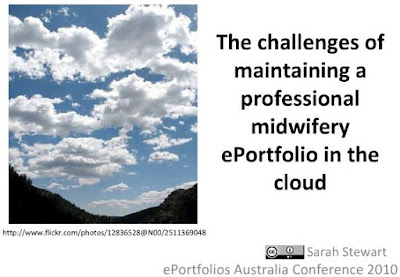
Screenshot of Sarah Stewart's SlideShareClick above to see the SlideShare


I have been following the progress of Sarah Stewart's work, exploring how the ePortfolio can serve the midwifery service in Australia. Her presentation, as indicated above, is a valuable consideration of the problems involved in introducing ePortfolio thinking into any community.

However, many of her 'frustrations' follow on from my previous post, that of overcoming 'Stone Age thinking'.

Perhaps one of the first issues to overcome is that of the technology. If it looks complicated then it IS complicated. For adults who are not as IT savvy as they could be, and have plenty of other things on their minds, it is essential that whatever ePortfolio system they choose, it should be 'childsplay'. It should be easy to use and immediately attractive.

Secondly, Sarah's presentation illustrates the generation gap in ePortfolio thinking. It was not only the midwives who found difficulty in adopting ePortfolios, it was the assessors and administrators who were at least reticent if not downright reluctant. It is time that governments recognised this situation and sponsored urgent adult training in ICT for all generations - and particularly for services, such as midwifery, that require portfolios.

Yes, the lack of equipment, of resources and of broadband availability needs to be recognised - and it may be some time before much of Australia gets the service it deserves!

However, speaking as an experienced teacher, it would appear that Education Authorities must reflect upon their own consciences and ensure that the upcoming generation is properly and speedily trained as the 'net generation. One thing that we have learnt here in the UK is that by ensuring that our children have good 'Home Access' that their parents, carers and even grandparents are having to learn ePortfolio thinking.

Tuesday, 19 January 2010

Second Generation ePortfolios?

Logo: 2G eP?For some time now I have been getting increasingly frustrated by the large number of mainly HE institutions who are continuing to promulgate e-Portfolio theory and practice which is increasingly looking some ten years out of date. I have therefore coined the hardly original acronym of 2G eP, pleading for a second generation approach to e-Portfolios, starting afresh from first principles rather than basing ideas on outmoded thinking.

Despite all the intelligence, wisdom and experience of our noble institutions it would appear that educationists are still saying, 'Here is a tool, what can we do with it?' rather than teachers saying to the developers, 'This is what we want to do, get on and give us what we want.' Quite frankly, eFolio can provide all the facilities that an e-Portfolio should deliver but, for now, let's just explore what we do really require.

Part 2

Perhaps the most immediate requirement is for some clarity. There is presently far too much confusion about the separate functions of a VLE and an e-Portfolio. Course management, and information about assessment criteria are surely the responsibility of the institution. Where helpful to the student one might accept that a copy of assessment criteria could be held within the e-Portfolio but with a good VLE that is hardly necessary. Otherwise, the e-Portfolio should be seen as learner-owned, separate to the VLE and the implications of this need to be fully explored.

The argument has been made that the e-Portfolio is inevitably institutionally based as it is designed to meet the needs of a particular course and even a function within that course. This again is 'tool thinking' rather than 'user-thinking' or 'meeting the variety of needs of each individual'. I raise these issues in my document, first published some two years ago: 'Who's hijacking our e-Portfolios?' To sum up a seven-page article in one sentence: e-Portfolio thinking should not be defined by conventional capabilities but by modern teaching and learning theory. In this regard, a better understanding of collaboration, of peer review and the general benefits of web2.0 will begin to influence the way staff manage formative assessments and the general monitoring of student progress.

Another challenge to take-up across all academic stages is that of the FE institutions. If HE can be seen as having a silo-mentality when it comes to e-Portfolios then FE must be considered as doubly disruptive. My paper, 'A Bridge too Far?' considers the whole situation in 6th-forms and FE colleges. It has been argued that FE has a higher percentage of older teachers and lecturers – this may be marginally true but is still no excuse for the serious lack of CPD supported in FE.

The beauty of eFolio is that different views can be presented concurrently to different audiences - and thus obviating the necessity to model one's e-Portfolio according to the needs of a particular course.

The issues of transition or portability appear to be incapable of meeting any satisfactory conclusion and thus the student is tempted to give up and accept that the e-Portfolio is owned by an institution. This inevitably means that as the learner moves on to another institution yet another different e-Portfolio tool may be required with repeated uploading of artefacts. The owner is therefore tempted not to invest any additional time or effort beyond the minimum required. Perhaps one of my main arguments about the ownership of eFolio is the very fact that through the provision of templates and the facility to change 'skins' and fonts etc not only the younger learner but all learners can create an environment that expresses 'This is ME' – that the learner is proud of and wishes to retain.

If HE has troubles concerning vision, if FE has troubles relating to staff training then Mainstream Education suffers from both of these and more. As much as teachers may expect autonomy within the classroom there is still a need for central advice and direction. For the last four years BECTA has been miserably silent on the issue of e-Portfolios and has utterly failed to provide the leadership and inspiration required for a national initiative. At the same time there is a growing demand from the 'Is it free?' brigade who seem to be unaware of the failure of basic DIY e-Portfolios to meet the strict requirements of e-safe management that schools are required to maintain. It is therefore time for some serious 2G thinking.

I can do no better than to refer back to my original criteria, my 'Ten Prime Directives'. But perhaps I can address these in a different order.

'Cosmeticisation' – an ugly word but essential. Users of any age, from the youngest to the oldest, from the most able to the least able all should be able to modify the templates, style, fonts and images which make up their own chosen self-representation. Note that there is a difference between this and 'personalisation' which, for me, suggests the functionality of the software to recognise one's personal learning styles and preferred software, including such t hings as diagnostic and predictive tools.

Lifelong Learning: can only really be an option if the one e-Portfolio can use the above options to 'transmogrify' or change according to one's maturity, culture, social perspective, course of study or even one's favourite football team or current pop-group. It should be capable of changing the organisation and naming of pages and the addition, editing or removal of artefacts.

'Lifewide' has two distinct meanings. It can refer to the range of users, ie the one tool should be capable of being used by a number of different abilities within one class or group. However, it more significantly refers to the fact that any one person has a number of different personas, any one of which the learner may wish to present to a specific audience. For example, I may wish to represent myself to one group as a competent technician, to another as an HR manager and yet to a third as an environmentalist wishing to do work for a charitable organisation.

Portability is an essential function if the e-Portfolio is to have any credibility as a lifelong tool. However, most e-Portfolio solutions are institutionally based and repeatedly I have heard tales of frustration that the work a student has done in college on their e-Portfolio cannot be taken with them to their next institution or place of employment. This has often led to older students doing as little as necessary or responding with exclamations such as 'Why should I bother?' However, portability is an essential feature of 'transition' and, from my own experience, can include many movements from one school to another and on to yet another.

Tuesday, 29 September 2009

The Advantages of E-Portfolios in Teaching

Photo: Adrienne CarlsonE-portfolios are beginning to gain in popularity as the entire world embraces digital technology and the online way of life, but e-portfolios still have a long way to go before their full potential is realized. For those in the dark, an e-portfolio (when used in connection with teaching) is a collection of the work of someone in the pedagogical field which reflects their ideology, their views and thoughts on teaching, a list of their accomplishments and talents, the courses and classes they teach, and so on. In short, an e-portfolio for a teacher is similar to the portfolio artists carry around in order to showcase what they’ve achieved and provide a teaser of what they’re capable of. There are various advantages in using e-portfolios when you’re a teacher:
  • It’s easy to update and rectify: Any data stored in a digital format is easy to maintain because you don’t have to rewrite entire documents when you make a mistake. Updating information also becomes a piece of cake because the process is almost effortless.

  • It helps you become a better teacher: When you have a readymade package of all your work and your ideas and thoughts, it’s easier to analyze your style and refine your presentation when you have a plan for the future and work towards it. When you’re able to show others what you stand for as a teacher, you can prove yourself more effectively, especially when you’re aiming for a promotion.

  • It proves you’re tech savvy: When you show that you’re familiar with the technology used to create and maintain an e-portfolio, you prove that you’re tech savvy, a skill that many teachers lack. In today’s world, you must know and love technology if you want to keep up with all that’s happening.

  • It allows easy access to your work: When you have an e-portfolio, it’s easy to put your work online so that more people have access to it. This way, you’re showcasing your skills to a larger audience and providing yourself with appropriate exposure.

  • It allows you to use multimedia: When you’re able to include pictures, videos and music in your e-portfolio, it gives it much more depth than using just text alone. E-portfolios allow you to use multimedia to your advantage and showcase your ideas and skills with much more strength.

  • E-portfolios save space: No matter how much information you want to add to your e-portfolio, you can do so without worrying about space constraints. It’s easy to include information and events as they happen, because digital information is compact and concise.

E-portfolios are just becoming well-known as tools of the trade for teachers, as well as within some other sectors such as Health Care & Nursing. With more from the pedagogy field embracing them, they’re soon going to become the norm rather than the exception they are now.


By-line:
This guest article was written by Adrienne Carlson, who regularly writes on the topic of online degrees . Adrienne welcomes your comments and questions at her email address: adrienne.carlson83@yahoo.com

Thursday, 27 August 2009

Cloud Computing for all?

'Cloud Computing' image from Dreamstime.comJust a brief post in response to one from Tony Bates. He makes reference to a recent EDUCAUSE 2-page document entitled '7 things you should know about Cloud Computing' which is a well balanced paper and well worth reading.

As the abstract says:
Cloud computing is the delivery of scalable IT resources over the Internet, as opposed to hosting and operating those resources locally, such as on a college or university network. Those resources can include applications and services, as well as the infrastructure on which they operate. By deploying IT infrastructure and services over the network, an organization can purchase these resources on an as-needed basis and avoid the capital costs of software and hardware. With cloud computing, IT capacity can be adjusted quickly and easily to accommodate changes in demand. Cloud computing also allows IT providers to make IT costs transparent and thus match consumption of IT services to those who pay for such services. Operating in a cloud environment requires IT leaders and staff to develop different skills, such as managing contracts, overseeing integration between in-house and outsourced services, and mastering a different model of IT budgets.

However, before teachers all jump on the bandwaggon of 'free resources', as I have hinted at before, two things need to be considered which the author, P. Kurkowski, forgets to mention. Firstly, younger pupils, the less able, some disabled students and the elderly may require systems that are much more e-safe than the responsible average HE student may require. Secondly, Cloud Computing lends itself very much to the ideosyncratic choices of applications that teachers may never have experienced. The provision of support for an unknown number of different applications would become a nightmare if no forms of control were established. - But who would advise students to invest in a product that has no guaranteed future or who may be hooked into a system that suddenly starts charging for its services?

Addendum:
For a most erudite and lengthy exposition on cloud computing see Stephen Downes' article. He starts from the basis:

In the cloud of connections, we each become social neurons, mimicking the biological human brain but on a giant scale. This collective knowledge is far beyond anything a single search engine could index and archive. Intelligence is spreading everywhere, every minute, and cloud computing can draw new links across new ideas.

However, for an even more challenging read, see the site: Day 81: Ars Electronica Symposium Examines Cloud Intelligence one extract must suffice:
Jules Verne published his novel at the dawn of industrialised globalisation, when the steam engine and the colonial conquests of Europe made it possible for the first time to circumnavigate the planet in relative comfort, and in less than three months. In the 125 years since, the pace of globalisation has accelerated exponentially. Our cars, clothes, computers, and cupboards all depend on vast international networks of manufacturing, finance, and trade. This flood of globalisation has carried the economic and environmental crises to almost every corner of the world. Are these crises an inevitable part of human nature? Or is it possible to shape a new connected consciousness to tackle global problems collectively and equitably?

Welcome to the
cloud. Welcome to new the social ecology of the 21st century. Welcome to mobile banking from a New York taxi cab direct to rural Kenya. Welcome to the wild wondrous web of blogs, podcasts, mailing lists and streaming video from camera phones the size of credit cards. All instant and all the time. The world has changed. We have changed.

But, I would ask, has 'Education'?